Day 4: Proekt 365

Day 4: Proekt 365 My first finished object for 2014. It will not be the last.

Day 4: Proekt 365
My first finished object for 2014. It will not be the last.

What on earth did I do before a friend re-introduced me to the world of knitting and other needlecrafts a few years ago? Has it really only been three years since I picked up a pair of needles and dove into the fine fibre world of k2, p3*?

It’s hard to believe, but, yes, just 3 years ago my friend Brad (who lives in Amsterdam with his fabulous husband and bestest of hounds, Rusty) talked of knitting, and I asked if he’d be willing to show me how at some point. At the time, I was quite stressed and thought it might be a way to re-focus my mind, whilst also providing a creative outlet. It had been years since I’d knit anything and I never really finished a project. I was more of a happy hooker in my youth (minds out of the gutter, please!). In an incredibly kind gesture, Brad gave me a set of bamboo needles and provided a bit of instruction and inspiration just before / after New Year’s Eve 2010-11.

Little did we know….

When I returned to Helsinki after that New Year’s trip with my husband, I found a group of expat women in Helsinki who are a part of the American Women’s Club in Finland and who meet regularly to knit, crochet, craft and generally support and help one another. Not only did I get some incredibly helpful guidance on knitting, but I’ve also and perhaps more importantly forged lifelong friendships with quite a few talented, brilliant and exceptionally kind women.  I honestly don’t know how I’d have mentally and emotionally survived these past several years without knitting, but more specifically without the friends I’ve made through my crafting journey.

Knitting has also reminded me of one of the most amazing women I’ve ever been fortunate enough to have in my life — my grandmother. Katharine ‘Babe’ Louise Baring Fuller was not only one of the wittiest and strongest of women I’ve ever known, she was incredibly gifted with a rare and precious talent.

Born and raised (in Texas) at time when women’s roles were very much different to today, and when skills such as sewing and crafting were expected rather than honed as luxurious hobbies, she took her craft seriously. When I was a young girl, she taught me the fine skill of touching and feeling fabrics before looking at labels to determine quality and fibre content. When working on a particular craft, she demonstrated how patience is just as important as technique — if you rush a project, you’re likely to mistakes no matter how skilled you are (which is a lesson that transcends all of life it seems, and one which has taken a long, long time to finally learn).

In addition to her random acts of silliness and infectious laugh, I will forever recall how zen-like she was when crafting. She was an expert seamstress who made her own clothes and whose sewing ‘station’ I would do just about anything to have now. Sewing for her was more a matter of necessity since she was so, so tiny and petite sizes were rarely if ever an option. We would browse the latest fashions  on offer at Saks and Neiman’s and then she would go buy the fabric and make it herself. Her skills were impressive then; but, I am even more in awe of her now that I understand just what goes into making one’s own clothes without a pattern. She was incredible.

But, her real artistry and talent was most visible in her needlepoint. From the very large Christmas stockings with images and scenes matching the passions and personalities of each family member she made one year to the various throw pillows around the house and pictures of idyllic scenes on the walls of every family member’s home, the woman was absolutely gifted. Her work was impeccably perfect and each viewing reveals further details that were all of her own design. Needlepoint mesh was her canvas, and she painted with passion through her needles and thread.

The image of her sitting serenely in her love seat surrounded by the tools of her craft with a look of utter solace and complete focus and joy as she worked is forever burned into my consciousness. Zen and the Art of Needlecraft, I say. And, it’s master is and always shall be Grandma.

Whilst I wish that I could share my projects with her now, it comforts me to feel as though I’m carrying on her legacy. (I’d say big shoes to fill, but the woman had incredibly tiny feet!) It may be a different type of needle and thread (although she did knit and crochet as well), I know she’d be proud and it gives me no small measure of joy to know that at least some of her talent seems to have made its way to me.

She’d also find all those various dropped stitches, and totally understand and relate to my quest for perfection in everything I knit or craft.

Knitting has given me infinitely more than I ever expected. I can’t imagine a day that didn’t include some form of crafting even if for a few stolen moments. From knitting to crochet to quilting or sewing, each stitch reminds me of the friends it has brought my way as well as how it connects me to my beloved grandmother. As if all of that wasn’t enough, it has also brought me an unusual form of mediation and a few lovely pairs of socks, scarves, hats and blankets to ward off the winter chill.

For all of this and infinitely more, I am immeasurably grateful. (Thank you, thank you, thank you, Brad and all the Helsinki Knittas!)

*k2, p3 refers to ‘knit 2 stitches, purl 3 stitches’, for those not in the know. 😉

Day 3: Proekt 365

Day 3: Proekt 365

Day 3: Proekt 365

I love coffee. The darker the roast, the better. The richer, deeper the flavour, the better. If you asked me to give up coffee, it’d have to be for something incredibly extraordinary to warrant any consideration at all (e.g., ending poverty and all forms of social injustice, all wars and acts of violence and human suffering). Even then, I’d have to really think about it. (I jest…but only slightly.)

From that first sip as a young girl, I have enjoyed a special relationship with coffee. And, each day begins with coffee first and foremost.

At one point in my life, I always had a cup of coffee with me. This habit was so persistent and recognised amongst my social network that a professor of mine once brought me a comforting cup of coffee minutes before a presentation at a national conference. I cannot tell you how much that boosted my confidence (and how much it meant to me on a personal level as well — thanks, Bill!). It was also at that time that my thesis advisor and I would discuss research and work on her NIH project and my thesis project over an afternoon coffee break, often sharing the cup of very fine coffee she was making for herself. (Honestly, I didn’t arrive ‘just in time’ on purpose, Kathy!) At that time in my life, I was probably a 20-cup a day coffee fiend. Pretty much every part of my day involved coffee and I’d never, ever turn down a good cup of joe. Once, my local supplier in Connecticut asked me to taste coffees as a means of quality control in order to help them decide to contract a new supplier (I gave the supplier a thumb’s down and left that little treat of a tasting quite literally flying). I’ve long since cut way back on my daily caffeine intake, partially for general health reasons and partially to allow me to sleep a little more easily.

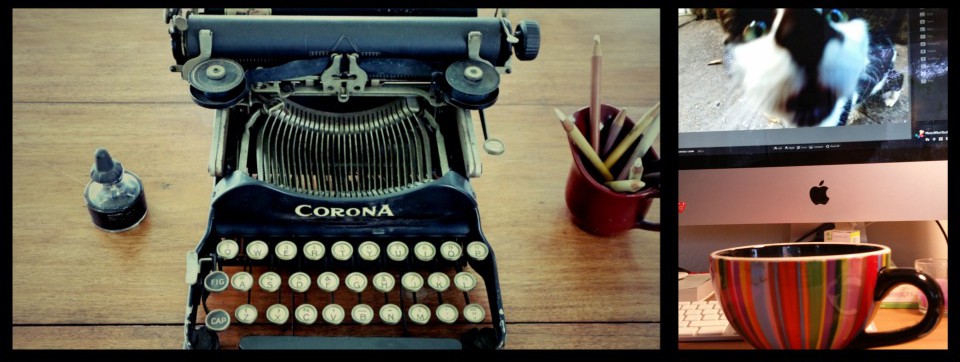
My daily coffee routine (or ritual?) these days is consistent. My first ‘cup’ (which, if you’ve seen my cup, resembles a bowl with a handle rather than a traditional 8-oz cup) brews whilst I am launching the various applications I use every day at my desk. Mostly, I am just wasting time until I can get that first cup down my gullet and coursing through my veins. I’m useless until I have at least half a cup of my go-go juice in the morning. During that first cup, it’s my time to sort out my goals and targets for the day, take care of any lingering administrative crap, tidy up the kitchen if necessary and generally enjoy a calm, quiet and serene start to a new day.

I’m now a two- or -three cuppa girl and generally consume those luscious cups before 15.00 or 16.00 in the afternoon. (This is no problem since I’m an early riser on most days.) I must have at least one full cup before I leave the house (which does mean setting an alarm to allow time for that precious re-fueling ritual) and will leave the house with the second in hand. My favourite coffees are all dark roasts: Ethiopian, Tanzanian Peaberry, Sumatra Mandheling, Brazilian Kalosi, Guatemalan Antigua and, of course, Cuban Turquino. One of the best coffees I’ve ever had is the typical hard currency Cuban brand, Cubita.

I was recently reminded of the ‘origin’ of coffee, which is silly and awesome at once. Evidently, 12th century goats danced from bush to bush eating those fine berries, which was observed and copied by their goatherder, Kaldi.

‘Hooray for goats!’, I say. And, thanks, Kaldi! I cannot imagine a world without coffee.

Day 2: Proekt 365

Day 2: Proekt 365 reminder that my

Day 2: Proekt 365 

We don’t do holiday / birthday gifts much in our house. Rather than fret about and participate in the commercialisation of various holidays and occasions, we tend to buy random gifts when we see them and as ways of surprising one another and ‘spend’ those holidays / occasions just being together and without the pressure of the ‘perfect gift’. Nothing is truly a Christmas, birthday, anniversary, [insert occasion of choice] gift. Instead, they are random acts of love and appreciation throughout the year.

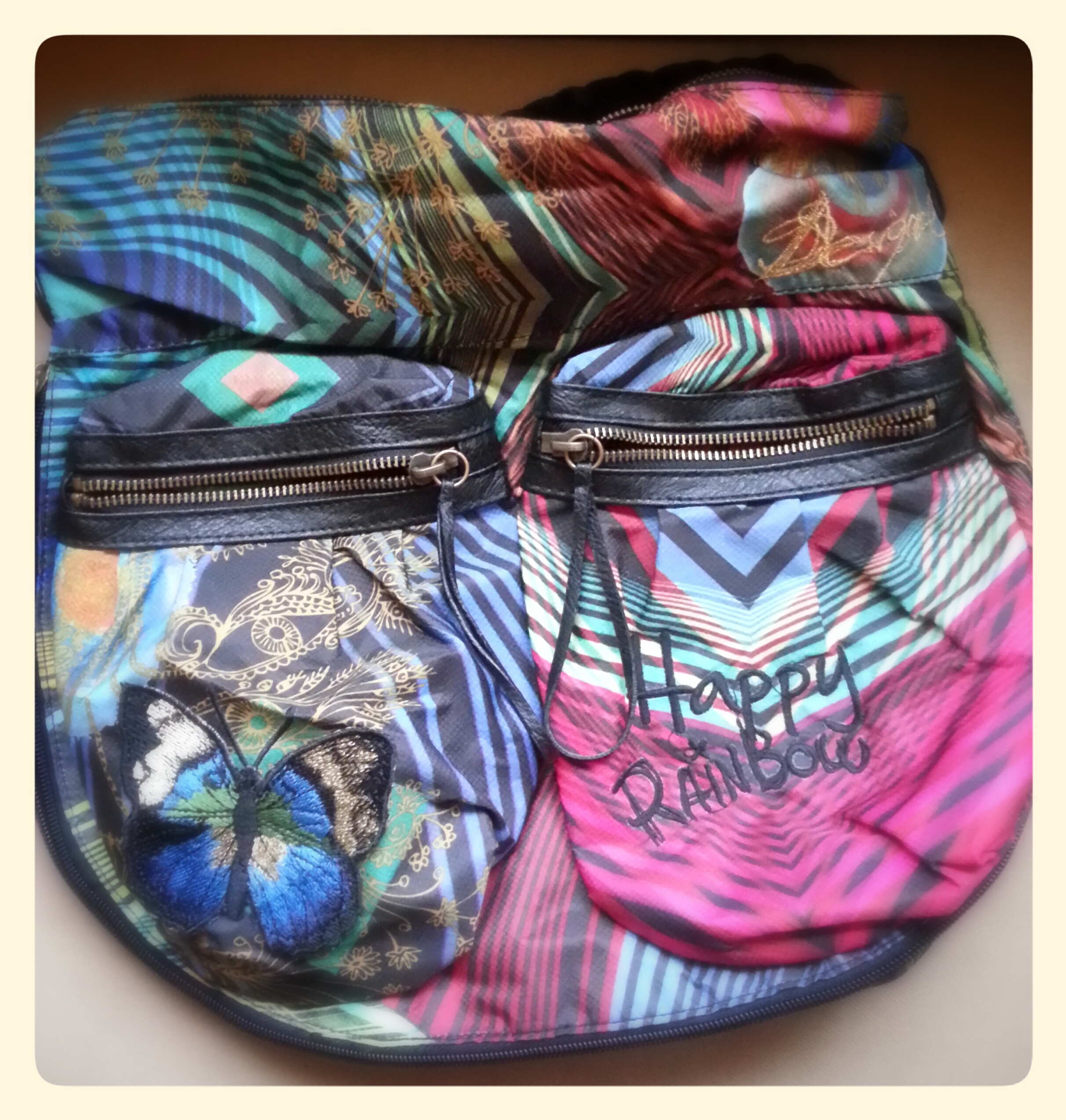
Today, the latest gift from my darling husband arrived and I LOVE it. Why? Well, it’s bloody gorgeous and bright and cheerful, and from one of my favourite clothing lines — Desigual. But, mostly, it shows just how much my husband loves me and accepts me for me.

One of the last things I truly need is another handbag / messenger bag / bag of any sort. There are no less than 6 hanging from the back of my chair (which is where I keep the ones I use most often and switch between most frequently), 3 more in my desk (mostly for carrying my laptop), and then who knows how many in my closet. I definitely do not need another handbag. At all.

But, I desperately wanted this one when I saw it. It’s big, but not too big. It’s bright and pretty. And, it has just enough pockets and compartments both within and outside. Easy access to various bits is key in picking out any handbag. Plus, it is slightly expandable for when I decide I must carry just a little bit more. And, as if it needed anything else, it has a great big embroidered butterfly on the front. (I love butterflies of all sorts.)

I could have bought it for myself, and was planning on doing so. But, The Cuban decided that he would beat me to pulling the shopping cart trigger and bought it for me. Why? Because he loves me, and he knew it’d make me smile.

Smiling, I am. And, I shall definitely smile frequently whilst using this lovely, lovely gift from the person most important to me. Thank you, Sweet Pea! And, I promise, I won’t want a new bag for at least a few months! 🙂

Proekt 365

We all need a project (or проект, if you like) or two to inspire and keep the creative juices flowing. Today, I found a project which I thought was a) excellent in terms of the timing given that it’s a new year and b) a lovely way to work on another goal of mine that I’m using to combat bouts of depression and the doldrums which accompany winter in Southern Finland. Specifically, I’ve been trying to re-focus on more positive aspects of daily life.

I stumbled across the following video today:

Committing to taking one photo a day is easy enough; committing to taking one photo a day of things which bring joy and beauty to my world seems daunting, but also a rather simple way of re-focusing and solidifying the habit of re-focusing on the loveliness in life.

So, here goes….

I keep seeing images with the caption, ‘Tomorrow is the first blank page of a 365-page book. Write a good one’ (which is a quote from Brad Paisley?). Cliche, perhaps. But, okay. It’s a new year and there are many vomit-inducing aspects to it.

What I love most though about new years most is not just the opportunity to look forward and think of life anew, but the chance to reflect upon the past year and close the book on a small chunk of the past, just to continue with the over-used metaphor. What did this past year mean? What were the highlights and low points? What can be learned from the many lessons lived through?

Then there is the hope that a new year brings. Truth be told (and perhaps it will be short-lived), I’m excited by and for this coming year. For the first time in several years, there is no impending and potentially devastating or discouraging process which we must face. We have more options and choices open to us, and we have a small measure of security — finally! This isn’t a small thing at all given just how traumatic and uncertain the last several years have been. It’s bloody huge in reality. And, that’s the beauty in this year. This entire year in which we can make decisions for ourselves rather than waiting on one bureaucrat or another to make them for us.

Today, I’m delighted to begin anew and refreshed, one of the brightest things in my life is my little tiny calendar. It may be old school (paper calendars work better for me even though I keep a digital diary as well), but I love it. To me, it represents hope and opportunity. It’s bound to get messy at times, but that’s what makes it interesting and inspiring.

Day 1:  'Proekt 365'

Day 1: Proekt 365

Farewell, 2013! Hello, 2014!

One year ago, my hopes and wishes for 2013 were simple enough: secure residence permits for my husband and I in a single country (not as easy as you’d think) and secure steady work for the both of us after a few difficult and lean years.

One year on, we can happily mark both of those wishes as fulfilled. And, that ain’t nothing.

This year has been such an incredible roller coaster. As we say ‘farewell’ to 2013, our hopes for 2014 are again simple. Perhaps that’s as it should be. Along with ambitions and resolutions to improve our health and be fitter, eat better and waste less, and to be better, kinder humans, what we actually work towards is rather simple: a life worth living; friends and family with whom we can share the good, the bad and the mundane; contributing to a better and more humane world even if it is on an infinitely small scale; and an occasional moment of ‘wow!’ thrown in just because we all deserve those.

Upon reflection, 2013 brought incredibly great tidings to us. For that and all the many things for which we are fortunate we are grateful and thankful, especially to all those individuals in our life who helped and supported us during several tumultuous and uncertain years, and through a residency permit battle which was epic. Despite the disappointments and heartbreak that are inevitably a part of life, it hasn’t been a completely shitty year.

Now, for 2014. Twenty-fourteen!

May it be a year filled with more joy than sadness, more hope than fear, more gratitude than disappointment, more kindness than strife and more understanding and compassion than disinterest. May it be filled with health and great food, and may you and yours enjoy inspiration in whatever you do and all that you do.

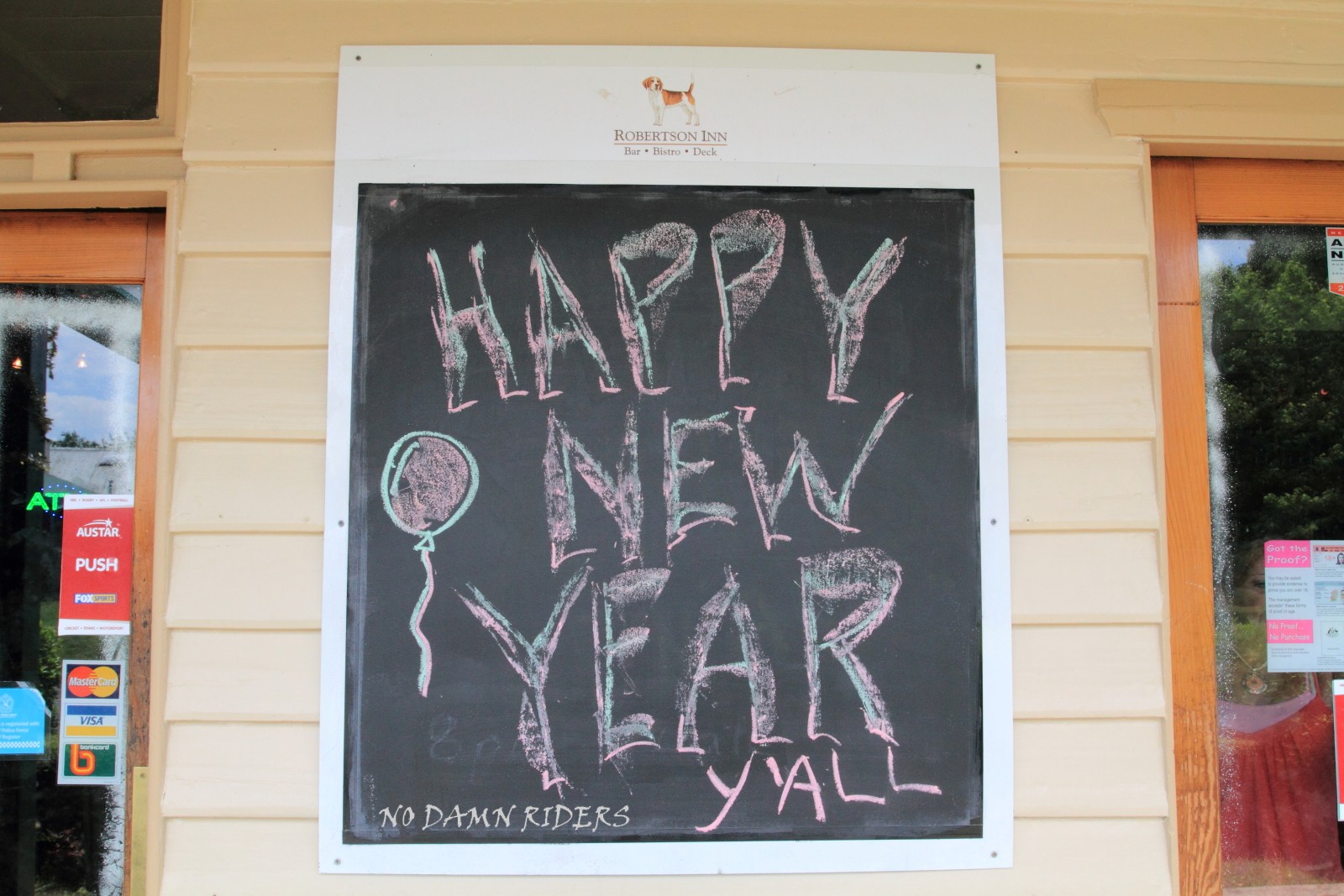
Happy New Year, y’all! С Новым Годом! Feliz Año Nuevo! Onnellista Uutta Vuotta! Gott Nytt År!

To The Women Who Choose Not To Have Kids

My own reasons for not having children are complex and varied, and entirely my own. The responses to many I’ve met who can’t get their heads around my own decision not to bear children have been less than kind and often quite judgmental and absurd.
That said, I love my own step-son and my closest friends’ kids more than I know how to express. And, it’s a real treat to be in and a part of their lives.

What we are taught, part 2

Over breakfast one morning when I was maybe 14 or 15 years old, my grandfather advised me to ‘keep [my] knees together’. To this day, I have no idea what prompted this seemingly random statement.

As an awkward adolescent sitting at breakfast in a restaurant with her family, I was mortified. From the faces of everyone except my grandfather and the choked chortling coming from the wait staff, it’s one of my most vivid memories of my grandfather and one I’d rather not recall quite so easily. The message, however, was as clear then as it is now: my own actions as a girl or woman will be interpreted by others and either invite judgements of virtue or exploitation and I alone hold responsibility over whatever happens. In other words, what happens to me (sexually) is my ‘fault’.

Horseshit, I say, now as I did then. I am of course responsible for the choices I make and decisions I take. But, I am not an object.

Nearly 30 years later and armed with a firm understanding of feminism, sexual justice, and the notion that there is no justification for the subjugation or exploitation of anyone, it’s discouraging to hear what is passing as a project aimed at today’s youth in West Virginia.

Labelled Project Future Two-a-Days, the ‘social media and drug education’ programme launched in August is aimed at high school athletes and guiding them on ‘avoiding trouble on the internet‘. Basically, it teaches young athletes how not to tweet, text or post to social media any evidence which might incriminate them or lead to criminal charges against them.

That is, things happen when you add drugs, alcohol, smartphones and raging hormones. Don’t share it via social media and here’s how you can avoid getting caught.

Maybe, in all this training, we can insert a little bit of guidance on not sexually assaulting young girls? Maybe a little something about ‘consensual sex’ and its meaning? And, hey, whilst we’re at it, maybe we could talk about safer sex? Since the programme mentions drug education, maybe we can also add a little about responsible drinking and drugs behaviour as well?

But, no, the idea is to not get caught — not to not do it in the first place. That it is designed for young male athletes is rather shocking.

News this week has showcased yet another town’s lovely treatment of a pair of young girls who were raped (at a star football player’s home and by him and his friends), one girl being left for dead on her lawn in freezing temps. Despite both physical and digital evidence, despite eye witness accounts from the younger girl and several of the other boys there, and despite what appears to be confessions from the two boys who assaulted the girls, the charges were mysteriously dropped. Instead, the two girls — one 13 and another 14 — were blamed for what happened to them and much of the town stands firmly behind the boys who perpetrated rape whilst publicly shaming the girls.

‘They asked for it’. ‘They deserved it’. ‘Matt 1: Daisy 0’ read one viscious t-shirt — Matt being the star football player, Daisy being the girl left for dead. That t-shirt was worn by another girl.

How many times will this happen? How many times has it happened and gone unreported?

The Rape, Abuse & Incest National Network provides a depressing answer to that last question: out of every 100 rapes, 54 go unreported. Only three out of every 100 rapists will spend a single day in jail for the crime(s) they commit. Three. I think we can agree that that is appalling.

From RAINN (http://www.rainn.org/get-information/statistics/reporting-rates). Sources:  1.  Justice Department, National Crime Victimization Survey: 2006-2010; 2. FBI, Uniform Crime Reports: 2006-2010; 3. National Center for Policy Analysis, Crime and Punishment in America, 1999; 4. Department of Justice, Felony Defendents in Large Urban Counties: average of 2002-2006; 5. Department of Justice, Felony Defendents in Large Urban Counties: average of 2002-2006.

From RAINN (http://www.rainn.org/get-information/statistics/reporting-rates).
Sources:
1. Justice Department, National Crime Victimization Survey: 2006-2010; 2. FBI, Uniform Crime Reports: 2006-2010; 3. National Center for Policy Analysis, Crime and Punishment in America, 1999; 4. Department of Justice, Felony Defendents in Large Urban Counties: average of 2002-2006; 5. Department of Justice, Felony Defendents in Large Urban Counties: average of 2002-2006.

There is no justice figures like these. Whilst these are figures for all rapes regardless of age, given the reluctance of most kids to talk about sex let alone sexual violence and drugs and alcohol with their parents, it’s easy to imagine that most instances of rape in adolescents go unreported to anyone. But, by all means, let’s start programmes which teach young men how to get away with sexually assaulting young girls.

Gloria Steinem may have been speaking on a seemingly unrelated issue when she recently said that we need to ‘change the culture‘. But, that seems precisely what we need to do. Rather than teaching boys and young men how not to get caught and to not post videos or pictures of their friends raping young girls, we have the tools and responsibility to teach them how to respect young girls and how NOT to rape young girls. We should spend a little energy and time imparting upon them that girls and women are not simply sexual objects — young girls are equally important and valuable — intellectually, socially and culturally. Let’s provide young people with healthy notions of relationships of all types.

And, while we’re at it, let’s teach young girls (and young boys) that have been sexually assaulted that they won’t be blamed for the heinous acts perpetrated against them. They will not be shamed by their community simply because the popular, well-connected individual is the guilty party. It is not their fault when a violent crime is committed against them.

The only way we can change the culture of rape and the culture of objectification is to call it what it is and hold those accountable for turning a blind eye. And, we commit further crimes when we blame those against whom such crimes have been perpetrated.

Thirty years on from that mortifying breakfast and I am realising nothing has really changed. But, that doesn’t mean it can’t.

Crushing hope

The worst crime we adults commit is not murder or theft or the bodily harm of another. It’s crushing the hope and dreams of children, particularly those who look to us as members of their immediate and extended families and to whom they look as role models and guides.

It’s tragic enough when adults lose all hope of a better tomorrow; but, destroying that belief in a better life, a promise of tomorrow among children is unconscionable.

This weekend, we caught a documentary from Appalachia which leaves little room for hope—for parents or their children. Oxyana, a brilliant crowd-funded documentary directed by Sean Dunne, is gut-wrenching in its honest talks and unfiltered intimacy with residents of Oceana, West Virginia, a small town nestled deep in the Appalachian mountains. It is a film which provides very little in the way of hope.

Oceana has been renamed ‘Oxyana’—an indication of just how much of the town has been impacted by oxycontin dependency. Members of the community recount how Oceana was a different place a mere 12 to 15 years ago before oxycontin was commonly prescribed to residents for pain and ‘anxiety’. Now, oxy dependence is epidemic. Person after person tells of their own oxycontin dependence, or the horror of watching their family and friends fall into prescription pill addiction. As one interviewee recounts, no one in the town has been spared the loss of at least one person close to them to overdose. Indeed, one such individual who appears on camera and is incredibly lucid and open about his use and distribution recounts how his own father committed suicide after first killing his wife and other son over what appears to be the mother’s prescription drugs. It’s a rather chilling moment in the film for obvious reasons.

The town’s dentist weeps as he talks of his own girls growing up in a town amongst good people who have no hope. His girls’ friends have lost parents to overdose. And, yet, he remains in the town and tries to hold on to hope for himself and for his girls. A physician from the local hospital explains rather dispassionately of the number of overdose deaths they encounter in the hospital each day (not week) and how 50% of all babies born in the hospital are on methadone to combat the dependency with which they are born.

In the final moments of this compelling documentary, a young woman, herself dependent upon oxycontin for pain and ‘anxiety’ talks of how she just wants a better life for her daughter, for herself. It’s when talking of her daughter that she truly breaks down.

The cycle of poverty, joblessness, and a life in which dope offers an escape from the physical and mental pain provides very little in the way of hope. Dope and a sense of overwhelming despair largely resulting from poverty and hopelessness have a vice-like grip on this small mountain community. If an individual doesn’t work in the mines, they are most likely already dependent upon on oxy. And, so, the cycle continues.

Diane Sawyer, a native of Kentucky, also used the power of journalism in a documentary ‘A Hidden America: Children of the Mountains‘ to bring to the masses the crushing weight of poverty which is characteristic for more than a half million residents of Appalachia and which for most of the rest of America is unimaginable. That she focused on the lives of children in incredibly desperate situations added yet a further blow.

Drug use and dysfunction feature in this second narrative prominently. But, mostly, crushing poverty provides little in the way of hope for a brighter future for any of the children. ‘Faith’ helps one cling to the idea that the future will be better — for her and her troubled mother. Yet, watching, hope is largely absent. As a young girl describes the only two contents of their fridge at times being mayo and ranch, you want to weep. At least I did.

What have we done to leave these communities in such situations? What have done that a physician describes the current generation as the ‘lost generation’? Are they well and truly lost? Or have we and with us they simply lost all hope?

We have failed these communities and more importantly those individuals who despair in such situations. Whilst we have the tools to help them medically, what will we do to assist them medically or socially? Because they are nestled away in an isolated community, will we continue to turn a blind eye and ignore their pain and suffering and relegate it as their problem alone? What message does that convey to the children who live in such situations?

And, what hope are we offering them, any of them? Or, have we simply crushed all hope for Oceana?

On civility

Merriam-Webster defines civility as:

polite, reasonable, and respectful behavior.

The interwebs are filled with anything but civility today.

For most of the rest of the world, watching the discourse coming from not just Washington DC but the United States in general most likely lies somewhere between reviews of the worst theatre production ever and an unthinkable reality show capturing a mass of petulant, pouting, spoiled brats hurling food, mud, insults and anything else at one another (check out the comments in the link). What’s worse is that those actors this very large schoolyard bully fest don’t have the slightest inkling what they are actually fighting about anymore, other than that the other side is just ‘wrong’ and ‘immoral’ and they are not.

There is scarcely little in the way of public displays of civility between waring factions in the US anymore between politicians between friends and even between family members at times. What happened?

I’m not a member of any political party in the US or elsewhere. I can see merit in many positions (although I confess that I do find most of what the Tea Party spews to be utterly incomprehensible and unconscionable). But, I don’t 100% agree with any party on every single issue. Who does? I’ll certainly entertain policy outlines and listen to agendas which attempt to solve a problem or provide a solution to an issue which faces us all and which keeps human rights and dignity at the forefront. I’m open to debating issues as long as it doesn’t become personal and attacks are not launched at a party or class or group of individuals categorised as ‘the other’ or those ‘who are to blame’.

We are all humans. We are all guilty of some sin or another just as we all have good within us. And, frankly, we should all share a portion of the blame for the situation in which we now find ourselves. No one is infallible. No one is above reproach.

But, increasingly and especially at the moment, having any sort of discussion is like sitting several centimetres from a tinderbox doused with a litre of petrol and a burning match dangling ever so closely to where the tinder is just beginning to smoke. Sparks are flying ever so closely and we all seem in danger of erupting fully and violently (I include myself in this — I am under no illusions to those who might think otherwise). It’s a little frightening to me. As much as I love to discuss policy and politics, there are many moments when I’d rather not since I know the inevitable flame wars will ensue.

Again, what happened?

If we cannot create a safe space in which to voice our concerns as well as our ideas and solutions, we’ll never find common ground and we cannot hope to find a happy medium. If we ever hope to regain that greatness and promise of a brighter future for our children and grandchildren, if we are ever to begin to address the most pressing issues of our day, we must regain that sense of collective good. To do that, we must keep discussions civil and even-handed, and we must remain open to alternatives.

I’ll do my best. Will you?

800px-Constitution_We_the_People

Gentle reminders…

The past few weeks (months?) have been an exercise in plodding through and continuing onward. To what and where are not exactly clear, but that’s secondary.

As I continue to process ‘life’ for want of a better descriptive and work through various ‘issues’, I share two links which I have gone back to repeatedly in the past few days.

First, a gentle and beautiful reminder to us all from the lovely Peter Gabriel and Kate Bush:

Give those near and dear to you a hug and tell them that you love them and appreciate them and are proud of who they are. You never know when your chance to do so one last time has passed. Or, simply listen and know that you are not alone.

Second, a quick read which provides much fodder for all of us and an incredibly useful inventory of steps which have absolutely zero to do with flat abs. I don’t think any of these steps are particularly easy; but I do think we could all benefit from taking them to heart and attempting to make them a part of our daily lives and mindset. I know I could. If doing so leads to flatter abs, m’okay.