Vengeance is not justice

In 2002, I spent about two weeks in Israel, primarily there to chaperone young Russians during an economics summer school at Hebrew University in Jerusalem. But, more so, I was there to work, scouring through institutional archives for a project related to the institution at which I worked in Moscow, founded by a giant of a man from Israel, the late Gur Ofer. That trip changed me in ways I still feel today. Particularly today.

When Gur picked me up from the hotel on Sunday morning to drive me to his office on campus, he was pensive. (He often was, but this was something far deeper and more tinged with worry than simple intellectualising.) He was listening to the radio, which I clearly did not understand given that it was in Hebrew. Waiting for him to share his thoughts, he finally said simply, ‘I’m worried. It’s been too quiet for too long, and *this* quiet feels ominous. That quiet might change during this trip. Please make sure that you have your phone on at all times and I can reach you. There is concern that the quiet is about to break.’

I can’t remember now exactly when things changed and, honestly, I quickly mentally blocked it, But, several days into our trip the first bombing occurred. There would be two more during our stay, two of which were chillingly close to where we had been in those moments. Just after my trip to Israel, the cafe I lunched at when working on campus was bombed. You knew before you saw the news what had happened because every single mobile phone in your vicinity rang / chimed with calls and messages asking if the owner was okay. It is a sound that haunts me still.

That’s the thing about terrorism. It is random and unexpected and leaves you terrified. That’s kind of the point. Indiscriminate killing is precisely the point.

In the face of yet more seemingly inexplicable violence, two things about that trip remained with me and come to mind whenever violence erupts in Israel / Palestine, even now, 21+ years later.

First, Israel is so incredibly small. I did not travel to the furthest southern point during that trip. But, I did travel to the north, along the borders with Lebanon, Syria and Jordan, and around Lake Galilee and then down to the Red Sea. Ramallah was visible from our hotel, which shocked me for some reason. This was before the walls around Palestinians were erected, but there were signs of what was to come. And, the spaces demarcated for ‘Arabs’ / Palestinians were shrinking already then. They have shrunk further now and continue to do so as each new settlement is sanctioned. But, it was the smallness of the space which shocked me, given what a large mental space that land continues to occupy in our policies and debates.

Second, with the exception of the ultra-conservative and hardline Zionists—some of which were gathering for their own conference (rally) near our hotel and which offered an utterly surreal perspective of how narratives of erasure can be remarkably and chillingly similar when uttered by one group or another—everyone wanted peace. They wanted a place and space, mental and physical, free of violence and in which their children could play and grow up and old. They wanted to laugh and smile and live their lives, untethered to their phones and sudden alerts or the f*cking news, knowing that the people they loved were not casualties in yet another senseless act of violence perpetrated by one madman or another. They simply wanted peace.

I do not know the answer to how to ‘fix’ Israel. Who does? But, I do know that whatever we’ve been trying to do for the last 100 years has not worked. And, honestly, right now it just feels incredibly sad. Not simply because of what has happened over the past several days, which is utterly heartbreaking and atrocious. But, what comes next terrifies me further. No one will ‘win’ this particular war. Not when two parties to it advocate openly for the complete annihilation and erasure of the other. I am horrified by the actions of the Hamas militants. I am also horrified by the words and actions of Bibi in the wake of Hamas’ actions. Why? Because I am still human and these actions are intentionally dehumanising.

Vengeance is not justice. And, there can be no peace without justice.

{NB: I wrote this after reading this piece, which appeared in The Guardian yesterday.}

On ‘This Land Is Our Land’ by Suketu Mehta

This Land Is Our Land: An Immigrant’s Manifesto by Suketu Mehta

My rating: 5 of 5 stars


This book resonated with me on so many levels. I hope that everyone I know, particularly those who think of migrants / immigrants as individuals to fear, reads it. With an open mind and an open heart.

This week marks the beginning of the twenty-third year I’ve lived in a country other than my home country. And, I would not change a thing. Perhaps that is why I read it both with a sense of hope and a longing for my own home.

I am and always will be a citizen and product of the United States, and I remain steadfast in my hope for her future as a country and for her people, whether they’ve lived there for millennia or recently arrived. But, I also understand that as much, as I love her as a nation, both her troubled and horrific as well as impossibly hopeful history, that we as a people have much to learn from others and that we must look at ourselves not as exceptional but as one of many people who share this big beautiful blue planet.

I can only speak of my experiences as an American living abroad. I view the wealth of our nation in skewed terms these days given my own personal lens. Whilst migrants exist everywhere, those seeking a life in the US occupy a central position within this book.

Our richness as a nation does not come from simple monetary wealth, but in the richness of the various people who arrive on her shores in search of something better and brighter for themselves and their children. To me, the diversity of our people offers glimpses into the richness of us as a species. Our ways of life. Our traditions. Our glorious, luscious, delicious foods. And, this melding of ideas and ideologies as well as cuisines offers us bits and pieces we may both carry onward and leave aside or savour so completely and fully.

Yes, I am an American. But, I am also one of millions of migrants in this world. My circumstances are my own, but the reality of being a migrant — both setting up and creating a new home whilst missing that which I left — is a reality I share with every other migrant in this world. All we ever hope to find is a place of peace and acceptance, and an opportunity to flourish and survive. Not as outcasts or others, but as valued and valuable members of the communities we now choose to call home.


View all my reviews

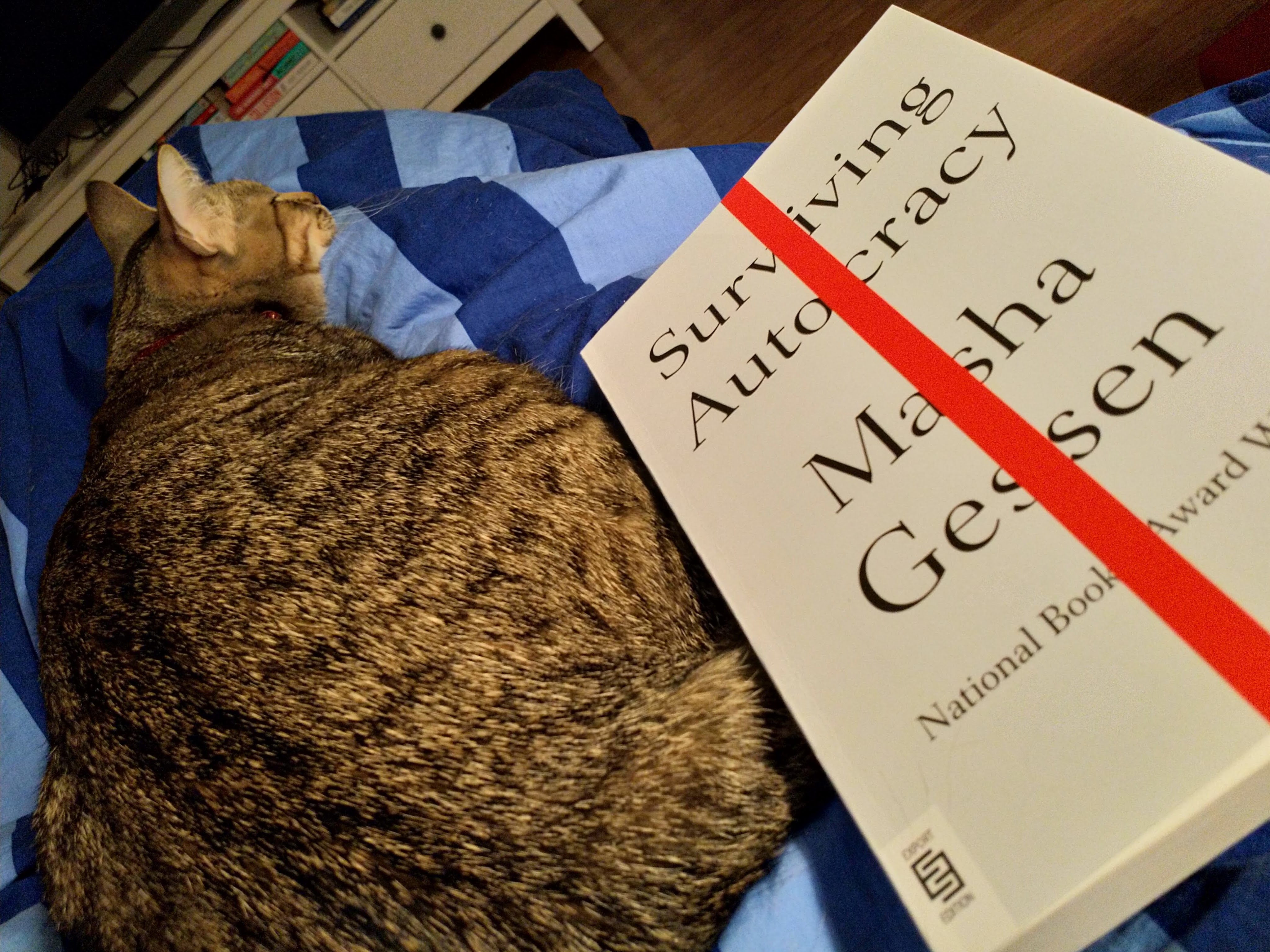
On ‘Surviving Autocracy’, by Masha Gessen

I did not intend on sitting down and ploughing through the remaining two-thirds of Masha Gessen‘s latest book, Surviving Autocracy, yesterday evening. But, that’s precisely what I did.

I regret nothing. (Although I did completely lose track of time and miss my weekly Ashtanga Zoom class, damnit. Let’s talk about white privilege and first-world problems a bit later, eh?)

It’s incredible to me how much of the past four-plus years have faded into our distant, collective memory. So, so much happened during the Trump administration, so many things which are frankly unimaginable, and so, so many things frankly made infinitely worse during the pandemic.

And, yet, so many of those atrocities were normalised rather efficiently and easily, as we moved from one insanity to another at a breakneck, mind-numbing and soul-crushing speed during his presidency (and seem to be continuing in his post-presidency period). It seems only fitting that now, just a week after his reign of terror (and I chose the word specifically) has ended officially he will also be tried in the Senate for a Second Impeachment. [It is not entirely lost on me or many that 45 Senators whose lives were also put in harm’s way during the Capitol siege voted to not proceed with that Impeachment trial because of course they did. I’m looking at you, Senator McConnell. Directly at you.]

Congratulations, asshole. You truly are the best at impeachments. No one single president has more, and you have 50% of them all to yourself. Well done.

Masha Gessen lays out with surgical precision just how utterly dangerous and quickly all of this has happened. And, I’m guessing, somewhat unintentionally provides sufficient evidence for why we are not quite out of danger of succumbing to Trumpism or quelling full-fledged and inescapable autocracy just yet. Chapter after eye- and wound-opening chapter, and in each of the three primary sections, Gessen provides more than ample evidence that we are in the midst of surviving autocracy.

Years of gaslighting, some of which predates Trump’s ascension, and more than 30,000 lies — not tiny embellishments or repeated falsehoods, but full on lies — and we are still dealing with those untruths, thanking no longer from his Twitter account. But, they are there. And, they continue, perhaps articulated a bit more eloquently and in a better package from a more polished messenger. But, those lies and the gaslighting continue. And, so many lap them up all for individuals so reckless, so vile and so callous and with a blatant disregard for lives of others in their charge.

But, this book is not a pity party or focused entirely on the rage-inducing history we are living. There is hope in between the despair. For instance, Masha applauds the civil society institutions and those with the moral authority who continually and unabashedly stood up to the injustices and atrocities and crimes these last four-plus years. Those institutions, sadly and surgically decimated in Putin’s Russia before they really had an opportunity to flourish and gain a foothold in Russian society and so precious to our own American experiment both at home and abroad, largely saved us. Yet, even they are exhausted and battered and bruised after four-plus years of battle. This final year, specifically, the final moments of mayhem notwithstanding, it’s a wonder any of those civil society agencies or agents still exist. But, resistance is a long war, not a single battle. And, that continued, tireless and sustained pushback has helped us perhaps prevented us from sliding in to complete autocracy. We still have far to go, however, and we can’t forget that more than 400,000 individuals have now lost their lives to Covid-19 in the USb alone from the inactions and lies spun by a White House and administration who cared not about us, but a great deal about themselves and holding on to power by any means necessary.

Since Masha finished this book in April of 2020, they did not have the opportunity to add their reflections on the protests that sprung up nationally and globally following the 8-minute live-lynching of George Floyd or the slaughter of Breonna Taylor of the hunting down and slaughtering of Ahmaud Arbery. Nor did they have an opportunity to fold into their book the genuine attempted to coup in the wake of the November elections and the siege of the Capitol as Joe Biden and Kamala Harris’ wins were verified, albeit somewhat delayed by those who sought to undermine free and fair(ish) elections in the US. Both of those broader events and the administration’s role in them are incredibly relevant to Surviving Autocracy. I’ll be looking for those reflections.

To me, the power of this book lies not just in Gessen’s arguments and the weaving together of a narrative that fits these last four-plus years flawlessly alongside the brutal realties of autocratic leaders elsewhere in the world. The power lies in Masha’s own history. Maybe it takes an individual who stood up to and faced Putin to rip off the mask of ugliness in a second homeland for us all, showing us those parallels we often think of as ‘other’, when in fact it is ‘us’ in this specific moment. That is, it takes the clarity of hindsight after witnessing an autocratic takeover of your homeland once to lay it all out for those who are too naïve or too hopeful or too optimistic and blindly faithful to an idea to realise that it is already happening to them in your second home.

This is an important book. Along the lines of Timothy Snyder’s On Tyranny and Sarah Kendzior’s Hiding in Plain Sight. It’s also tragic. And, that’s truly what these last four years have been: tragic, and sickeningly real.

But, we have survived (most of us), and we must endure and ensure that this never happens again. First, however, we really must stop the autocratic designs being laid out so carefully from taking a firmer hold over us and over those institutions we trust to prevail and protect us.

It might take all of us. But, we can survive autocracy.

‘I am a refugee’

Far too many Americans have forgotten what it means to seek refuge in a land far from home, with nothing but hope and whatever they were fortunate enough to travel with and carry. Far too many have demonised those who simply want a better life for themselves and their children.

Why?

Whilst thankfully I’ve not (yet) had to flee violence nor war nor a government persecuting me or my people, as a migrant I did find myself in the position of needing refuge in a land not my own. And, for nearly a year, my husband and I were what you could consider undocumented — we were neither illegally staying in Finland nor did we hold valid residents permits or travel documents. We could neither travel, nor really feel as if we were safe from deportation. It was the most unsettling and precarious time of my life. And, one I’d not wish on anyone.

After much paperwork, worry and many meetings, things eventually worked out fine for us — and we’ve been granted permanent residence and a place to call home in Finland. At one point during that year, we were asked and offered the possibility of seeking asylum given the circumstances of our specific case. Neither one of us considered ourselves refugees or asylum seekers. Our life was relatively stable and we understood our position of privilege compared to the millions of refugees seeking shelter across the globe.

As an American from the land of plenty, that moment and possibility was a very odd and surreal moment and a rather gut-wrenching realisation for me. It also allowed me to understand that a refugee can be literally anyone and they can be anywhere — there is no one type of individual who seeks refuge. Lives can and do change in the oddest and most tragic of ways and for a variety of reasons.

Refugees embark on journeys that are heartbreaking and unique, varied and often dangerous; and their entry into any country is not without a mountain of paperwork and enduring patience. They need not be demonised nor feared; they should be welcomed and heard and seen.

In the land of plenty, there is room for those who are tired, poor and yearning to breathe free. Most of us who were fortunate enough to born there more than likely have refugees of one sort or another amongst our ancestors.

At the very least, we can extend a hand of friendship and offer kindness. We can offer a seat at our table, the chance to break bread and share a plate with others less fortunate than us, and a warm blanket and safe haven from which to escape the horrors other have faced on their journeys to safety.

When we faced our own immigration woes, the kindness of friends and strangers alike helped us as we navigated incredibly uncertain waters. On some days, those kindnesses were the only things which made us feel human and worthy.

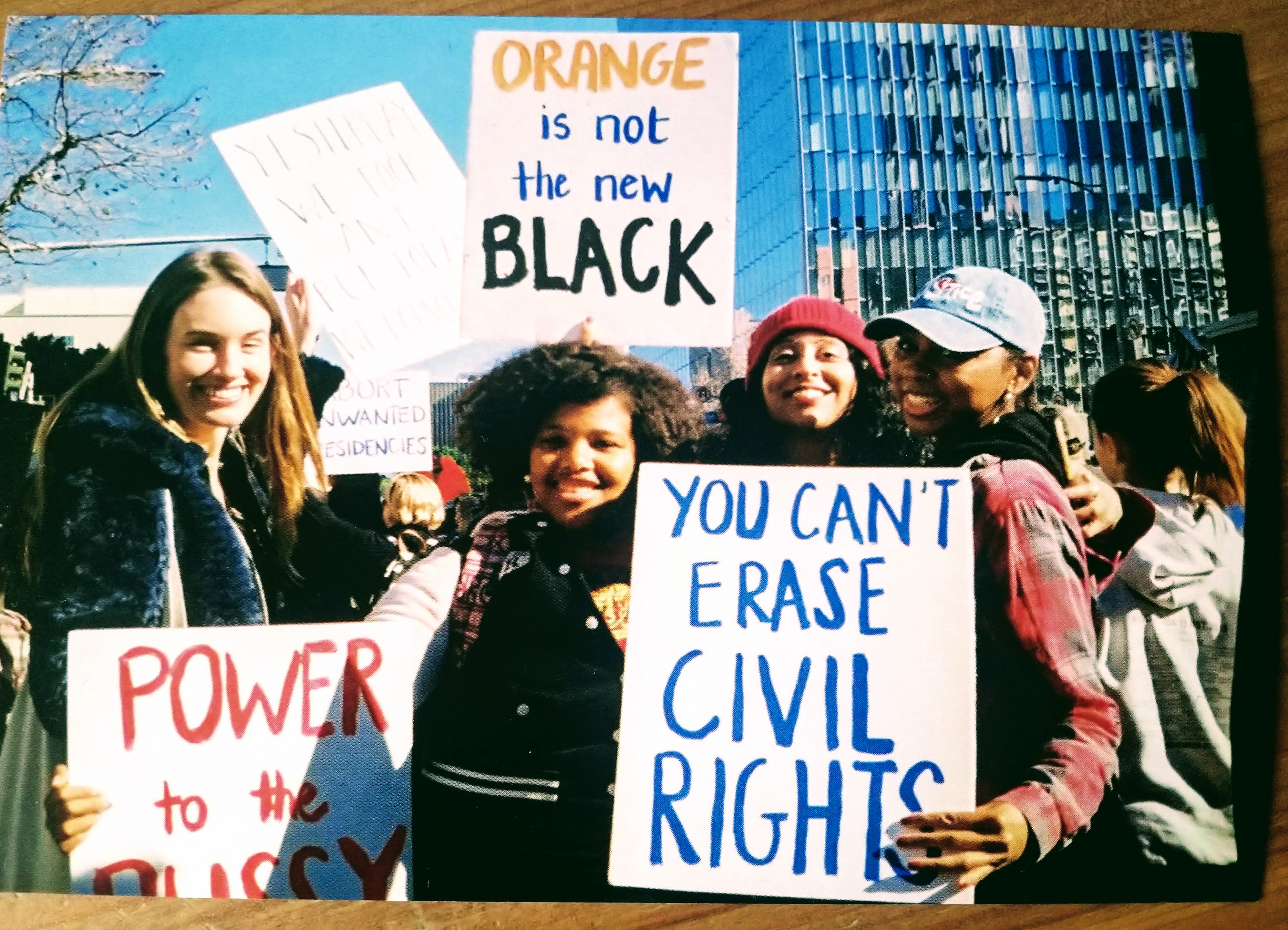
Protest Postcard #11 of 50

Continuing the fight for Civil Rights

In the past few years, I’ve been rereading much of the writings from the  civil rights era in the US. Familiar names like Martin Luther King, Jr. and John Lewis along with the works of  James Baldwin, Angela Davis and Malcom X and histories detailing the lives of Emmett Till and Medgar Evers have featured amongst my reading lists.

It’s crazy how relevant those works are today despite being 50 or more years old. Many of these writings could have just as easily been written today. We still need to make further progress vis-à-vis racial equality, basic rights and justice, particularly in making right generations and centuries of oppression and injustice along with a fair amount of racial violence.

Granting further for others does not intimidate me nor leave me fearful that my own rights will be somehow diminished or limited. More rights for you means I will not enjoy a benefit or privilege based simply on my race or class or standing granted by birth within a particular category. Understanding my own privileges helps me understand what systemic changes are necessary in order to achieve equity and in order to right historical wrongs, whether perpetrated by myself or my ancestors. Generational pain is real and persistent. Understanding that helps me do better and helps my communities become more inclusive and more just.

I’m thankful for a new generation of writers like Ta-nehisi Coates
and Ibram X Kendi and Chimamanda Ngozi Adichie. I’m enormously grateful to the many writers and activists who share their histories and their guidance on how we can be better allies and antiracists.

But, I’d be even happier if such works highlighting our need to continually work towards a more just society were unnecessary.

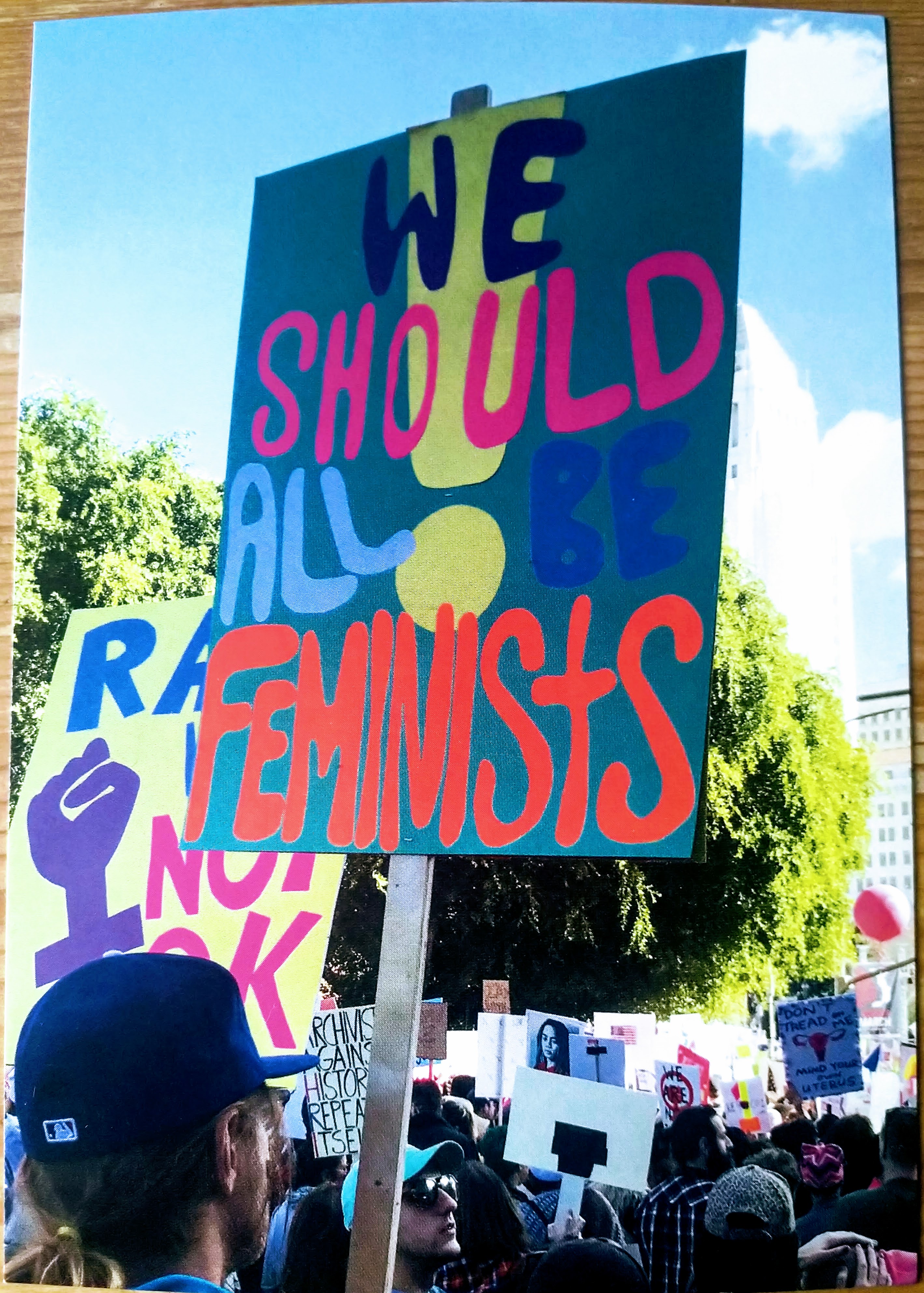
Protest postcard #10 of 50

We should all be feminists

We should all be feminists.

There’s a brilliant little book by the same name by one of my favourite authors, Chimamanda Ngozi Adichie. She’s far more eloquent than I, and I agree with her every word. We should all be feminists.

Indeed. There’s nothing more that I really need to say about this, is there?

If I do, here’s what I have to say: More rights for you does not mean fewer for me. It means we all benefit and enjoy equal rights and protections for and of those rights. And, it might just mean that women will not receive less pay for equal amounts of work, not needing to pull double duty by caring for all things related to the home and childcare whilst also excelling in our careers. And, it might just mean that we are finally be seen as belonging in positions of leadership. That we are capable.

Because, we are more than capable. And, we do it wearing heals and whilst also taking on the primary household management responsibilities.

I’m not sure why ‘feminism’ as a word conjures up man-hating women with no tolerance for men. But, it does. And, that fundamentally speaks to the primary reason why we need feminism.

And, why we should all be feminists.

Protest postcard #9 of 50

In this house…

I’m a bit behind — work and rest both kept me from posting a daily protest postcard here. [In my defence, I’ve done so elsewhere!]

In our house, we live by each of these phrases, particularly the phrase in the middle.

We are not threatened by equality; we embrace and work towards it. And, those individuals who strive towards equality are truly quality folks we’d like in our circle.

We seek to ensure that all human rights are honoured, particularly amongst and for women and girls.

Black lives matter. Full fucking stop.

Love is love, and it is a thing to behold and celebrate. The day marriage equality became a reality for all in the US was an incredibly happy day for us.

And humans can never be illegal. Their reasons for being undocumented are varied and complex, and largely depend on bureaucracies just as difficult to navigate as their journeys and attempts to escape unnamed or unknown horrors.

Standing up for any one of these principles doesn’t negate us or any of our own struggles nor does it diminish our own worth. In fact, standing up for the rights of others strengthens rights for all and helps to enshrine these principles into our society and community. And, that renders each of us more valuable and our communities more just and inclusive.

Protest Postcard #8 of 50

Intersectionality

Does the intersectionality of race, gender and sexuality really need further explanation?

Spend five minutes on social media and it’s clear that it does.

Perhaps it’s the anthropologist in me, or just a matter of my personality. I’ve long been interested in the interconnection between things, particularly the social constructs we humans use to inform our realities and world views. Specifically, how we decide who represents us versus who we view as them fascinates — and, at times, horrifies — me. But, those intersections and interconnections between categories, which place each us in various positions of privilege or groups to which discrimination and stigma are directed, are also used to divide us by the powers that be.

If we’re fighting one another, we cannot fight them. Hell, we might just miss what exactly they are doing to begin with.

My feminism is one which examines those intersections and attempts to empower those with the least power. It gives voice to the voiceless. Makes visible the invisible. Accepts the unacceptable.

I cannot divorce my ethnicity from my class from my gender from my sexuality. In my world, no one should need to. But, I can and try as much as possible to recognise where I fall along the intersectionality continuum. And, I attempt to work towards minimising the distance between categories along that scale for those less advantaged whilst aiming for the creation of an equitable, just and empowering society for all.

Pro-choice is pro-life

Today’s postcard is perhaps one of the issues that I feel most strongly about since for me it’s connected to just about every other aspect of my life and belief system.

One of the first national-level protests I took part in was the Women’s Rights March in Washington, DC in ’91 or ’92. The reason I took part was because I felt then and still believe today that no one has a right to decide what happens in my uterus or to my body besides me. My physician is naturally involved when medically necessary. And, my husband, of course, is apart of those conversations and discussions. But, the ultimate decisions and consequences are mine and mine alone to make and to bare.

Simply put: this is my body and this is my choice.

And, yet, here we are in 2020 continuing to wage war over women’s rights to do with their bodies what they want.

Women seeking refuge in the US from violence and war in their homelands have had their uteruses literally ripped out of them, forcibly and unknowingly and without their consent. Why? Because they are poor, vulnerable and other. Because they are considered unworthy.

That’s not pro-life — that’s limiting their reproductive freedom, and its tantamount to genocide. Persecuting Muslims because of the actions of some, murdering black and LGBTQI individuals because of racist and sexist and cisgender stereotypes are also not pro-life attitudes.

I am not pro-abortion; I’m pro-choice, because it allows girls and women the ability to make choices which have lasting impacts on their lives. I support allowing women to decide when and how they reproduce as well as how they prevent unwanted and unplanned pregnancies from occurring in the first place. And to me that’s always been a pro-life perspective,since it keeps abortion safe and ultimately protects women and their children from unnecessary harm. But it also allows for the means to prevent unwanted and unplanned pregnancies, thereby diminishing the need for abortion. Isn’t that the point? Minimising the need?

Against abortion? No one is forcing you to have one. Similarly, no one should force me or any woman to have a child she does not want nor feel she can care for. No one should be forced to continue a pregnancy and carry it to term if they do not want to. Women are not (yet) handmaids. I’ll fight like hell to make sure they never become them.

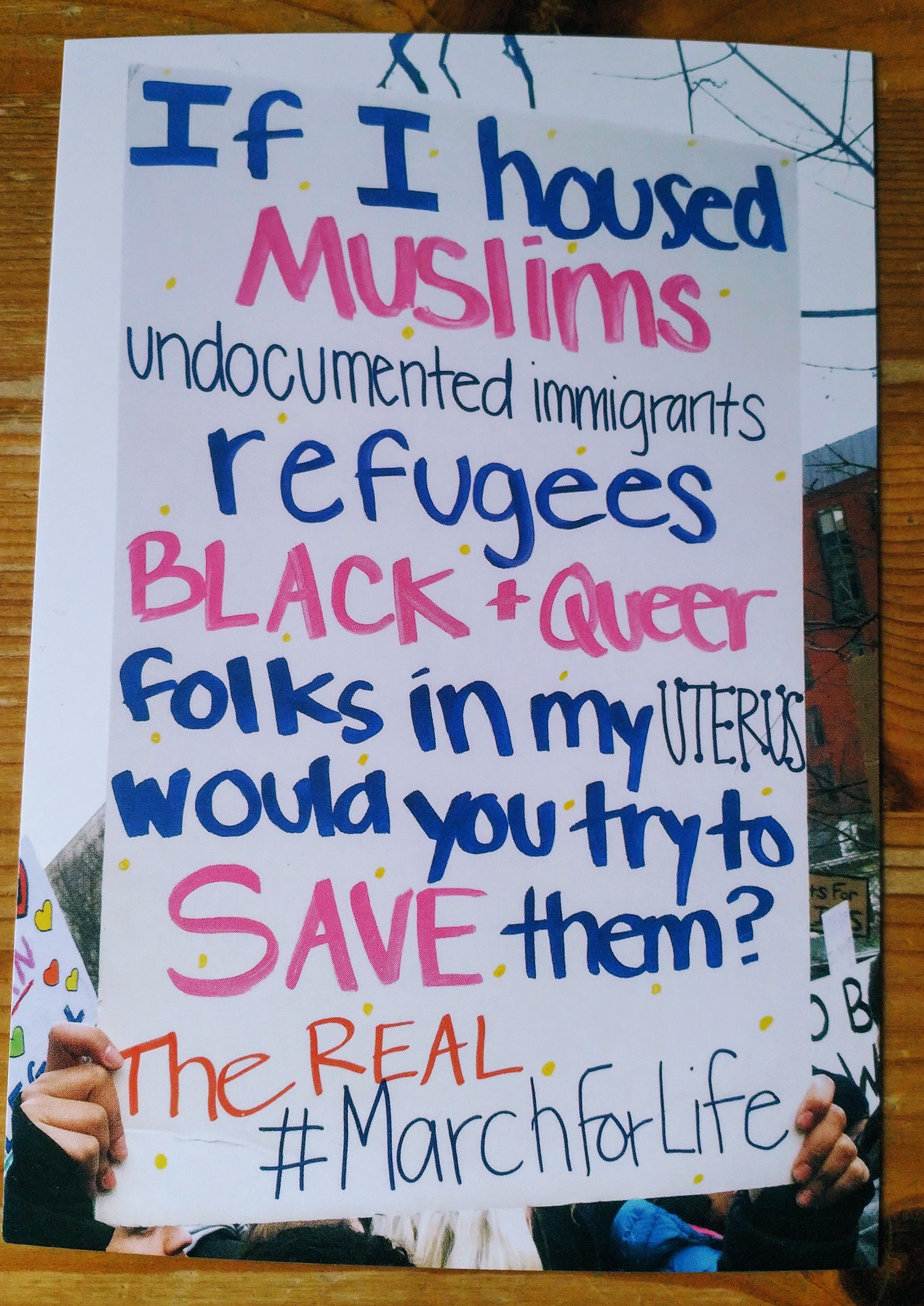
If you consider yourself pro-life, then do you also support and work to protect Muslim women and babies? Immigrants whether documented or not? Refugees? Black lives? And LGBTQI lives?

If the answer to any of those questions was anything other than an unqualified ‘yes’, then you are not pro-life. You are pro-foetus. But, what of that foetus once it is out of the womb? Do you still fight to protect it? Is that life still sacred?

It makes me incredibly angry that we still need to fight for this specific freedom. But I’ll continue fighting, not just for women in the US. But, for women everywhere.

Abortion should be legal. It must remain safe. And, it should be rare. But, that requires freedom for women to make decisions regarding their own reproductive lives.

The real #MarchforLife — Protest Postcard #5 of 50

Health care is a human right

Today’s image from the 50 protest postcards resonates with me for various reasons: some personal, others professional. And, all based on evidence.

I’ve long worked in public health. But, I’ve been an advocate and activist for universal healthcare for all for even longer.

One of the first issues which informed and guided my own political compass was health care. It astounded me then (late ’80s and early ’90s) that the United States was the only developed, high-income country in the world to not have a national healthcare system. It astounds me even more that we continue to occupy that bit of exceptionalism and that the discussions still rage on today in 2020.

I’ve also benefited from living in a country with a well-functioning, high-quality national healthcare system. It’s inconceivable to the average Finn that a resident or citizen wouldn’t be cared for from cradle to grave or that millions face financial ruin or death because they can’t afford the care they need. Or that individuals would need to subsidise and fundraise to afford care when faced with an emergency or life-threatening illness. This reality has become more stark to many in the face of Covid 19.

In the richest country on the planet, in 2020, we spend more on health care per capita than any other country by far, and yet perform worse far poorer countries on just about every single health metric. In fact, the only metric we outperform other countries on is spending.

What good is fantastic care if no one or very few can access it?

I support Medicare 4 All. That said, I’d be happy with a hybrid system, one which features both public and private options because I understand complete change may take time, and be somewhat scary for my fellow Americans.

To me, it makes sense and represents a more humane approach to offer everyone basic, universal healthcare coverage from birth through the end of life. And, if individuals wish to, they may also purchase private insurance and coverage. Choosing between a meal and insulin, a roof or cancer treatment, a tooth extraction or an electric bill should not be a viable or acceptable system. Not for the proclaimed richest nation.

No one should be granted care only because they are privileged enough to afford it. No one should be barred care because they are too poor.

People — all people — will be healthier if they are all able to access the care they need when they need it. And that’s good for all of us.

Postcard #3 of 50.