‘Humanitarian Reasons’…

My husband and I knew the process of applying for our permanent residence permits in Finland would be unpleasant and tedious. I don’t think either one of us was quite prepared for the hell we experienced yesterday.

For those already in the country, you must apply for all residence permits at your municipal police station in a designated section known as the ‘Immigration Police’. Lovely term for an utterly unhappy place. </sarcasm> The office for Helsinki is particularly unhappy. It recently moved and the waiting area is now much too large for the number of individuals they may assist on any given day. You arrive and choose a number from the electronic queue based on your purpose that day. And, then you wait until your number and the desk you must go to flashes on the various screens around the room.

We arrived and our number was ‘120’ in the queue for all nationalities. They were serving 20-something. This was at around 12.45. Oddly, all around the waiting area, there were signs recommending individuals to make an appointment online to avoid the queue. How one does that through the website we do not know.

Thus, we waited.

We were finally seen at around 17.20 or so, a full hour after the official ‘closing’ at 16.15. Our case worker was pleasant enough, but it did not go well.

Since we came to Finland through employment for The Cuban and he is no longer in that job, we cannot use that as our reason for being in Finland. When we explained that we can go to neither’s home country because of our governments’ policies, we were told to apply under ‘Other: specify’ for our reason for applying for permanent residence. Then, we had to specify that this is for ‘humanitarian reasons’ and explain what that means.

How do you describe on an inhuman and impersonal form that you just want to be with your spouse? And, how do you do that when you are sitting in a soulless, too-bright place with too many people around, whilst at the same time providing your fingerprints on an electronic fingerprint pad? And, how do you do that when the unthinkable outcomes flood over you and leave you in a complete panic?

Anyway, we now have to submit many other forms to supplement our applications. Some will require additional translation. Some we aren’t entirely sure will help our case. But, we are in for a very long journey. In our case workers words, it will take a ‘very, very long time’. How long is anyone’s guess. She had no idea, and that is a bit of a concern. (For easy, straight forward cases, the wait for a residence permit is about 6 months, although that is variable as well.) Our case once completed with the Immigration Police within the next two weeks will then go on to the Immigration Service and we’ll be assigned a separate case worker there with whom we’ll need to deal.

On top of that, once our current permits expire, travel becomes risky or impossible. For me it is less of an issue since I have a US passport, although there are risks. For my husband, he will be stuck here until this process is sorted.

At one point during our meeting, the case worker said to me, ‘I guess you don’t really want to go back to the US without your husband, eh?’.

Not an option. It’s simply not an option I can contemplate at all. ‘Humanitarian reasons’ indeed….

US$1 Trillion and Counting…?

It was always a foregone conclusion that I would attend university. But, I must be one of the only people amongst my friends who didn’t graduate from university or graduate school with crippling student loan debt.

Despite an early career as a ‘professional student’, which included an extended period spent ‘finding myself’ and finishing my undergrad (1988-1993, spent at two separate institutes and with enough credit hours to have at least three majors), a Master’s (1994-1997), and just shy of a PhD (1997-1999, with a few extra semesters still on the roster spent in absentia), I didn’t take out a single student loan. Not one.

To be completely transparent, from my third year onward as an undergrad, I worked at least part-time and had help (particularly with tuition fees) from scholarships and/or my family throughout. My entire graduate education tuition was provided for through assistantships and fellowships, and I was paid as a teaching or research assistant (at times very handsomely). I worked hard; and I played hard. But, I had no debt of any kind at the end of it all. Even the credit card debt I’d wracked up when times were leaner were paid off by the time I left the halls of the academy for ‘the real world’.

I am a rarity in the US evidently.

A few weeks ago, I stumbled across graph from a study carried out by the Federal Reserve Bank of New York (FRBNY), which included current college loan debt by age range and was astounded to see that a healthy percentagee of those in their 60s still had outstanding balances from their college days. A healthy 5.3%, in fact. That amounts to nearly 2 million individuals in their 60s! Think about that. You’d expect that an individual would graduate university sometime in their early to mid-20s. Then, get a job straight away, work for 30+ years, and then they still have student loan debt? How is that possible?

I well remember peers of mine in graduate school tabulating how much their education had cost. One such peer had a PhD from NYU, one of the leading schools in his particular field. Because teaching jobs at the time were few and far between, he could only get an adjunct teaching position, which meant he was paid about the same as I was as a first-year PhD candidate on a fellowship and assistantship. His student loan payments were double his rent and car payment combined, and he lived in a shit hole. Another friend who had completed his Master’s and was a brilliant archaeologist and historic preservationist had something like US$70 000 in student loan debt upon graduation. Finding jobs for them was more about survival than what they were necessarily trained to do or enjoyed doing.

According to the same study carried out by the FRBNY, student loan debt in the US now tops both outstanding automobile loans and credit card debt, and has been estimated at US$1 trillion. That’s staggering. Granted, that balance isn’t shouldered by one individual nor even one generation as the graph above shows. But, still. With roughly 37 million individuals (or 15.4% of those who have debt of any kind) collectively carrying that debt, that’s a heavy burden to bear.

From my relatively privileged position of not being saddled with crippling student loan debt, it’s easy for me to say that I fully support an education system which is free to all. Recent graduates have plenty enough to worry about—securing a job in their chosen profession, developing their careers, etc. For those who happen to marry and/or have children at the same time, which is perfectly within their rights, why add the burden of student loan debt to that list of concerns? Furthermore, shouldn’t we as a society want to see our citizenry well educated and trained, equipping them as much as possible with the tools they need to succeed in their professions?

If knowledge is power, why do we make it so difficult to gain a body knowledge? If it’s inherently better to teach a man to fish, why charge him with interest to learn to do so?

Surrealistic Pillow, pt. 1

Surrealistic Pillow, pt. 1

My dreams lately have been … unbelievably weird. Not frightening. But, just truly odd.

So, I thought I’d try a little series to look at over time. This might just peter out to nothing. But, it might also provide comic relief.

Today’s dream:
I’m in Moscow and trying to get .. somewhere. Not quite sure where. First, I have to navigate some sort of strange set of obstacles to find my bus. One such obstacle was insanely high and consisted of what I thought were bound bales of hay but ended up being old Christmas trees packaged very tightly. The only reason this was apparent was because of the newer and fresher ones that had just been added to the gigantic mound. (I didn’t actually get over this obstacle in my dream but obviously managed to since I eventually found the bus. The last of my dream that was focused on this particular vignette had me trying to get over it and tumbling back down to the ground when I lost my foothold.)

Moving on…

I’m on the bus. This was not a typical bus for Moscow. For one thing, the bus was spotless and didn’t smell of pickled cabbage or piss. And, it was shiny. It was more like a the inside of a bus in Amsterdam. The other difference was the people. They were… friendly. Not chatty by any means but certainly smiling and looking generally alright with the world and others in it.

As I’m happily enjoying a bus ride in Moscow (definitely not something I can say I ever enjoyed doing in Moscow), I then realise to my horror that I’ve missed my stop. All the ladies around me realise this as well and offer knowing looks of sympathy and words of support and encouragement as a lug my stuff to the exit.

When I get to the exit, I see this drunken, soiled man sprawled on the steps leading off the bus (doors still closed and bus still moving) mumbling incoherently (and obviously enjoying the mother of all benders) with a half opened, very large can of red salmon caviar next time, into which he is sticking his hand and helping himself to bits of ikra. (Insert big gigantic ‘what the f…?’ here.)

The babushkii standing around quite openly judging this poor soul encourage me to use the other exit and, wait for it, apologise for their drunken countryman. I run to the exit at the back of the bus where the nice, supportive ladies are and exit the bus to the sounds of ‘it was nice to meet you!’, ‘good luck, girl!’, and ‘safe journey!’ (I don’t think anyone ever spoke to me other than tell me to get out of their way or to ask what the next stop was in the 8 years I used public transport in Moscow.)

I get off the bus and find myself in the middle of a Finnish woodland.

Things that make you go, ‘hmmmm’.

Homage to the Annoying Bird of Spring

The first signs of spring in the far North are not green shoots peeping through on their way to becoming tulips or daffodils. Nor are they the green buds of new leaves popping out on the long-barren trees. Nope. We await the first calls of what we have come to know as the ‘annoying* bird of spring’.

When we lived in Moscow, some time in late February as the days grew noticeably longer and the sun finally peeped through the clouds after months of darkness and persistent snowfall, we would hear the call outside our flat. Our first reaction was invariably, ‘Was it…? Could it be’?! Then, we’d hear it loud and clear and know that all would once again be right in the world and the snow would eventually stop falling. The call was annoying in its repetition. And, annoying because we had no idea what the bloody bird looked like. Try as we might to find the annoying bird of spring upon hearing its signal of hope, we failed.

When we moved to Helsinki and landed our lovely flat in a wooded area with plenty of birds about, we were delighted to discover the call of the annoying bird of spring once again after one of the hardest winters we’d ever endured. It wasn’t so much that winter was colder than Moscow or that there was more snow; it is simply infinitely darker than anything we’d ever thought possible. The sound of our old friend delighted us no end, and told us we had survived. Spring was on its way finally and the darkness would give way to sunshine, green leaves and the long days of summer.

Yet, we still were unable to see the owner of that annoying, yet welcomed call year after year. ‘We hear you’, we would cry to our friend. ‘But, what do you look like?!’

My darling husband in particular has been obsessed with discovering the identity of that great signaler of spring. As his obsession was reaching epic proportions, I heard the most delighted shout, ‘I found it! The annoying bird of spring! Weeeeeeeeeeeeeee!’

Thanks to the a series by the BBC, Lolo’s Secret Life of Birds, and after close to five years, we’ve finally discovered the identity of our fowl, feathered friend.

We give you, the great tit.

This slideshow requires JavaScript.

The incredible irony is that on any given day, many of these lovely little creatures can be found perched on our very own balcony greedily claiming their treats from our bird feeder. A few days ago, I looked out and there were no less than seven of the cheeky little buggers sat along the railing!

All this time, what we assumed were finches were in actuality our beloved annoying birds of spring! To us, the great tit will always be the annoying bird of spring. And, its song will always bring a smile to our faces. But, its nice to know its true identity.

*NB: We don’t actually think this bird is annoying in any way. In fact, we love this bird and its song in particular.

Hope Where There Is None

For more than eight years, Moscow, Russia was my home.

As cliche as it is, I learned more about myself in that time than I ever thought possible, met amazing people along the way, and discovered a place that had been mythological in my post-Cold War imagination. As a child of the ’80s, Russians were ‘the enemy’. At moments during my stay there, they took on that persona to a tee. However, that was the exception, and I loved my life in Moscow and wouldn’t trade any of the time I spent there. So many individuals welcomed me as the ‘silly American’, and I miss the daily interaction with them despite the difficulties inherent in contemporary Russian life.

Perhaps that’s why it pains me to hear of how little things have changed in the five years since I left. Russia has the dubious distinction of being one of the few remaining countries in which the HIV epidemic continues to expand. What’s more, it has occupied one of the worst of all statistics as the country with the fastest growing epidemic in the history of the global pandemic. That is not an accolade any country should aspire to and most governments would take action to remedy it quickly.

That hasn’t been the case in Russia. In fact, the opposite holds true.

Primarily fueled by the sharing of unclean injecting equipment and compounded by one of worst tuberculosis epidemics in the world, the Ministry of Health has maintained its hostility towards ‘Western’ or ‘foreign’ evidence-based practices and prevention methods which could save a generation of young Russians and prevent the further spread of HIV. Many small-scale local-level projects were funded not by domestic sources by but international agencies such as the Global Fund to Fight AIDS, Tuberculosis and Malaria. Distributing clean paraphernalia and informational materials on safer sex and drug use, providing counseling and social support services to those who had no where else to turn, and delivering training seminars to local-level healthcare professionals to introduce international experiences and human rights-based approaches have helped immensely. Yet, as obvious as it might be, Russia is huge and reaching every corner without governmental support is impossible. Furthermore, as the funding from international sources has dried up, many of those local-level initiatives have had to close and left a gaping hole for those least accepted and cared for in Russian society.

It’s quite simply heartbreaking.

Much of our news in the West focuses on the Russian elections. However, there are many other unheard stories, both of unimaginable determination and heroism, as well as of tragedy and despair. The Andrey Rylkov Foundation has made it their mission to work towards a humane and just approach to drug use and fight for the rights of those who most need it, and listen to and respond to those most ignored. Engaging with drug users, they provide harm reduction services in and around Moscow. They also work to highlight the extreme positions of the Russian government towards drug treatment and harm reduction strategies which have been proven to help prevent HIV. Spend 20 minutes from your day and watch this video about what they do and why.

Is there hope? There must be. Is failure an option? Not really. Life in Russia is not easy. But, working with individuals who are considered social outcasts, undesirable, and many perceive the best solution is to simply ‘let them die’ is unimaginably difficult. But, it’s well-worth the struggle if it improves the conditions for even a few individuals at a time.

So, as insignificant as it may be, I just want to thank Anya and all those who continue to do this type of work. Keep fighting the good fight!

Family is family…

I’ve been thinking a lot about the composition and meaning of family recently.

For me, it has always been those who I know I can count on when things are very bad at a particular moment and those who share my joy at the happiest of times, my sorrow at the darkest moments, and the mundane for everything in between. For me, despite the distance between me and my biological family, I know they are ‘there’ and hope they know the same holds true for me. Obviously, my husband has been my daily family tie since we fell in love, and his gigantic family has welcomed me with the warmest of arms. But, my ‘family’ has also consisted of ‘my tribe’—a small group of several individuals whom I love and who love me back unconditionally in that way that only families can. None of this really has to do with any specific identity or sexual preferences. The most important qualification is love. Simple, honest, persistent love.

My pontification of ‘family’ recently has been more related to politics (of course) and how others find it so simple and necessary to define the meaning of ‘family’ for people they do not know. I’m a fervent supporter of marriage equality for all, largely because I see the desperate sadness of those who are denied that joy of defining their family for themselves. I also find it unconscionable that there are individuals who find it so repulsive. Largely, I’ve found that those who object to same-sex marriage are the very same individuals who deride LGBT rights in general because of the ‘promiscuous lifestyle’ of gay men whilst dismissing extra-marital affairs of their own as irrelevant and a ‘private matter’. Nevermind that there are plenty of examples of gay men and women who have been in decades-long relationships with their partners and never had an affair. Not that it is anyone’s business but that couple’s.

I don’t understand preventing couples in loving, committed relationships from enjoying the same legal rights as heterosexual couples vis-a-vis a recognised civil union. If a church wants to prevent it, fine (although I find fault with that as well). And, if the couple’s only ‘difference’ is that it is a same-sex couple, who is it hurting? Not the gay-bashing homophobes, surely. If they are concerned with examples of solid, loving and life-long relationships — e.g., preservation of ‘the family’ — why prevent two individuals who have lived together in good times and bad from publicly declaring that union and granting it the same legal protections?

I don’t get it.

Perhaps that’s why initiatives such as The Devotion Project are so incredibly important. Quoting their Facebook page, ‘The Devotion Project is a series of short documentary portraits of LGBTQ couples and families, chronicling and celebrating their commitment and love’. Couples and families.

The third video in their series, ‘Listen from the Heart‘, follows the lives of the Fitch-Jenett family. And, what a family it is. You need only listen to them to hear their devotion. Watching it and seeing the love and commitment is not only a shining example of how families should be, but should thaw the heart of even the staunchest opponent to same-sex marriage.

Simon is an incredibly lucky boy. If more children had parents as devoted to him and to one another as his are, the world would be an infinitely better place. And, many a heterosexual couple would do well to learn from their example.

World AIDS Day 2011

There are very few days anymore when I do not think of HIV or those who have been lost to the epidemic in the last 30 years. Alas, it is World AIDS Day so I’d like to dedicate at least a tiny space on my wall to this occasion. That is not to say that AIDS occupies a tiny space in my mind or heart.

It’s a bit bittersweet this December 1st. We are for the first time in the history of the epidemic painfully close to prevailing in our aim of reaching zero new infections, zero discrimination and zero deaths Treatment is now proven to be effective with less toxicity and, as an immeasurable added bonus, also prevents the transmission of the virus. The price of drugs have decreased dramatically in the last decade and thanks in large measure to programmes funded by The Global Fund to Fight AIDS, Tuberculosis and Malaria and PEPFAR millions of people who previously did not have access to treatment are now enjoying healthy lives once again.

These are great bits of news individually and collectively. They give hope to many. And, yet, there is also much to be less pleased about.

Within the last few weeks, The Global Fund has had to cancel its next round of funding amid very real and shocking financial shortfalls. Why? Because countries including my own which previously promised to contribute to the Fund have not come through. Without those commitments honoured, there is no way to fund programmes in some of the hardest hit and most impoverished regions of the world. Without those funds, those who have been placed on treatment may now find that the medications which have restored their health and improved their quality of life may no longer be available. Without those funds, in short, individuals will die. Senselessly and needlessly.

Thus, on this World AIDS Day, I find myself conflicted. I’m hopeful and angry at once. And, that to me is the essence of this epidemic.

Despite these bittersweet truths, I am mostly and profoundly grateful to know each of those whose stories collectively and individually are far more meaningful and profound than the simple slogan for UNAIDS and World AIDS Day this year or the economic reality of AIDS programming we face today.

So, here’s to all those living with HIV and to those we have lost far too soon. In particular, I’d like to thank those who have shared their stories with me—you have touched me in ways I cannot ever hope to express and honoured me in ways I’m not entirely sure I deserve. I remember you every day and not simply on World AIDS Day. Here’s also to the often invisible and forgotten individuals who dedicate their lives thanklessly to providing much-needed treatment, care and support to those affected by HIV.

Can you afford to be sick?

The debt ceiling ‘debate’ (although debacle seems more appropriate) has spurred many to trumpet the importance of cutting all spending, regardless of what that spending is on. Surprisingly, rather than focus on the most wasteful and senseless spending—fighting at least three wars which are resounding multi-year and multi-administration failures (e.g., Afghanistan, Iraq and the War on Drugs)—most of the discussion has focused on slashing the limited social protections we have in the US system.

I’ve long been a supporter of healthcare reform in the US and worked as an activist in the early 1990s to drum up awareness of the push for a national healthcare system for all Americans at a time when it was only just gaining momentum. It surprises me still how vehemently against a national healthcare system most Americans are even though they have witnessed decreasing coverage from their policies and exponential increases in their premiums and co-payments.

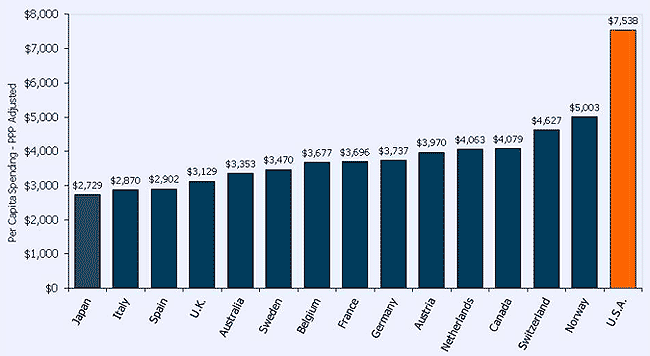
Spending per capita by country

We in the United States spend more than any other country on healthcare per captia by quite some margin. As of 2008, estimates by the Organisation for Economic Co-operation and Development (OECD) found that, after adjustments for currency and purchasing power parity, the US spent on average US$7538 per capita on healthcare. Compare that to the next highest level of spending per capita, found in Norway, at US$5003. Despite this spending, the US is just about equal to Cuba in terms of adult life expectancy (78.3 years overall for both countries). Yet, in Cuba, a mere US$260 per capita was spent in 2005 to the US$6543 spent in the US that same year.

Meanwhile, most Americans have experienced the dreaded pre-existing condition clause. That is, those individuals unfortunate enough to have been diagnosed with any sort of pre-existing condition are left without any coverage at all. I personally know more than a few individuals who will never be able to pay off the debt they owe for hospitalisations and/or treatment that potentially saved their lives. One friend has been an insulin-dependent diabetic since he was a child. He could not get insurance of any kind and rarely sought care because it was so expensive. As a consequence, he had a massive stroke at 29, experienced a prolonged hospitalisation and physical therapy, and now cannot ever hope to buy his own property given his credit rating due to the unpaid medical bills. He’s hardworking and always has been, and has even set up payment plans with all of the various providers for his stroke treatment. But, he will never enjoy the luxury of private insurance coverage.

I also know many (including myself) who have at one point in their lives gone without treatment even for minor conditions because they either could not afford insurance coverage or could not afford the co-payment.

This in a country which until recently has enjoyed unheralded wealth and one which boasts the best possible care available anywhere on the planet. That is, as long as you can afford it.

Contrast this to where I currently live—Finland. A friend of mine has the misfortune of experiencing breast cancer. She is a model of dignity and grace and bravery. It’s been a whirlwind for her and for those of us who hope to provide whatever support she and her family need to get through it. One of the eye-opening aspects of it all has been the exceptional (and incredibly timely) care she has received since her first appointment to check out a lump she found.

She was sent for an ultrasound, mammogram and biopsy within a few days of her first appointment to check out the lump. She received the biopsy results less than a week after the sample was taken. She was then scheduled for surgery straight away and had it the following week. Thus, between her first appointment and her surgery, a mere three weeks had passed. (She later found out that because of the type of cancer she has, someone else was bumped to a later date to allow them to remove her tumor more quickly, something which was key given the type of cancer she has.)

She is covered by the Finnish social benefits programme, which is more commonly known as Kela here and includes health as well as employment benefits, education, etc. Everything required for her treatment and medical bills is covered under Kela, and these benefits are the same for all residents regardless of what citizenship they hold. Her co-payments have been rather minimal. In her words, here they are:

  • ‘I paid €27.40 for my mastectomy surgery and another €27.40 for my overnight stay in the hospital!
  • My breast prosthesis, a special prosthetic bra and my hair prosthesis (wig) were all covered.
  • I’m taking a special drug to boost the production of white blood cells to make up for the ones the chemotherapy kills off. I have to take the shot each time I have a chemo treatment, and each shot costs €1300 euros! However, with a special waiver, I only pay THREE euros per shot. [NB: When she went to pickup her shot after her second round of chemo, the pharmacists suggested that she take three shots at once since they had them to hand. Thus, she paid a mere €3 for nearly €4000 worth of medications!]
  • In addition, once we’ve paid €600 out-of-pocket in a year, anything above and beyond that is fully covered.’

Contrast this to the experience of a friend hers who is in the US and also going through breast cancer. The day after her reconstructive surgery, her insurance company sent her a letter saying they would not pay for it. The day after. Can you imagine?

My friend here has not had to wait ridiculous amounts of time and has received exceptional treatment as well. It’s really quite impressive. And, as difficult of a time this is for her and her family, the experience has been somewhat less stressful because she is here and not in the US.

I know the tired arguments in the US against a national healthcare system which suggest that quality is compromised. That is patently untrue. Finland has one of the highest survival rates and treatment success rates in the world for several types of cancer. Beyond cancer, remember when David Beckham injured his Achilles’s tendon? He came to Turku, Finland, to see a particularly brilliant orthopaedic surgeon to have the tendon repaired .

I also know that many Americans baulk at the thought of their taxes being increased to pay for a national healthcare system. I don’t pay anymore in taxes here in Finland than I did in the US, and our quality of life is much better. Frankly, I’d rather my tax dollars went towards things such as improving the US education system and ensuring that healthcare was more equitable and not simply a luxury afforded by those who make enough money. Healthcare costs have been increasing for decades and will only continue to do so, largely due to the insurance industry’s stranglehold over hospitals, clinics and providers. Furthermore, we can still have private insurance and care alongside a national system, much as they do in places such as the UK and the Netherlands.

But, isn’t ensuring that all Americans have access to preventative as well as life-saving treatment and care regardless of their social, economic or political background a much better way to spend our tax revenue? Is it not more equitable and just? Would you not want to have that care for yourself or a loved one should you have an illness?

Things that make you go, ‘hmmm’….

I’ve seen a post on various feeds in the last year or so which recounts how ‘the Lord’ has taken one’s favourite actors and favourite singer. It then goes on to point out to the Lord that their favourite President is Barack Obama.

What gives?

The thing I find most troubling about this is that it comes from individuals who are largely devout Christians. I know that many of them are and have been against the presidency of Mr. Obama. And, they are perfectly entitled to hold that opinion. They are also entitled to criticise him and his presidency. But, wishing the death of the President (any president) through a prayer to the god they believe in seems to take things a bit too far, no?

Increasingly, discourse on the social, economic and ,especially, political spheres of life in the US has become so contentious that it is often impossible. Regardless of one’s viewpoints, individuals are apt to demonise and vilify those on opposite sides of their ideological spectrum to the point of not interacting with them at all. This seems so at odds with the principles of free speech and discourse upon which the US Constitution was framed.

As much as I firmly believe in the right of individuals to speak their mind and share their opinions, I do wonder if we have moved into a rhetoric of hatred which leads to things going too far. The recent tragedy in Norway serves as an all-too-real and painful example of how one’s words may influence another individual’s actions.

Perhaps it’s a bit too crunchy or New Age-y, but despite disagreeing vehemently with the policies of President Bush’s administration and some   members of the political right currently in office, I have never and would never wish for their death. I’d rather they be removed from public office, and I’ll exercise my right to vote to help get them out.

I can’t say that I wish ill on anyone who disagrees with me, regardless of if that disagreement is based on ideology or personality. I have my opinions and they have theirs. Full stop.

As much as we as Americans hold dear our right to speak our minds, I have to wonder if we as a society would benefit immensely if we tempered our rhetoric so that is it not filled with words of hatred, retribution, death, and despair, but one which looks for mutually agreed upon (or equally offensive) solutions. Just a thought…

‘No more boundaries; no more borders’…

The Two of Us

The two of us on holiday in December 2009.

I’ve been thinking a lot lately about borders and passports and documents.

The words of the late, great ‘Doctor’ Remmy Ongala fill my thoughts and best express them—the idyllic and unrealistic image of a world without passports, border controls and immigration officials.

The Cuban and I live in a world which is very much predominated by worry and fear of the unthinkable. We live in a country which is not our own. And, we live in a world which is focused on pieces of paper and an unimaginable pile of documents and endless applications. We are dependent upon one another for those documents which allow us to not only live in a specific country, but to continue our life together. The hard truth and knowledge that at the whim of any one bureaucrat we may be forced to abandon that life together fills our hearts and minds with an unspeakable fear.

Our crime? Falling in love with an individual from a country which our respective governments consider personae non grata.

I recently read an article about the horror faced by couples in the US in which one partner is either detained awaiting deportation or has already been deported. That is, families—real, loving families—have been ripped apart because of the decisions of others with only the specifics on a bundle of paperwork to guide them. it is unfair, unjust and unconscionable, particularly in a society which prides itself on ‘family values’.

Much of the discussion surrounding immigration reform in the US removes the context and nuances faced by individual couples. This has certainly been our experience both within and beyond the borders of our own respective countries. Yet, those specific details are what make individual cases so incredibly real and rich. And, heartbreaking. Most decisions are based on an inventory of checked boxes. When neither box applies, decisions are taken with no thought or closer examination of the individuals affected. Rarely do the consequences of those decisions warrant much attention or reflection, and therein lies the tragedy.

As The Cuban and I move through the incredibly frustrating and murky bureaucratic maze in our attempt to continue our life together, we still hope for and dream of a world in which passports, borders and immigration officers retain a bit of human compassion. We all inhabit one world.