I will not be terrorised

From a weekend in Paris in October 2010.

Findings words today seems impossible, if not entirely futile. Attempting to understand the insanity of yesterday’s events is proving less possible.

As my husband and I learned what was happening last night after a carefree evening in good company, we wondered if this was the new world order. Was this the new normal, where daily we go about our business knowing that another terror attack is likely, yet remain clueless as to where, by whom and against whom such attacks would occur? The scale of events in Beirut and Paris doesn’t pale in comparison to 9/11, yet the unpredictability rekindles the terrifying realities we all experienced that day. The seeming randomness once again leaves us wondering, ‘is our safe, peaceful life about to transform forever’?

But, that’s the point, no? To leave us so terrified that we fight through our support of another war in the guise of retaliation and justice against ‘people’ from no country at all, or huddle behind closed doors and barricaded borders fearing encounters with a nameless, faceless but ideologically foreign ‘enemy’.

As much as I do not understand what drives anyone to such lengths to commit acts of terrorism, I also do not and cannot support an equally oppressive and violent reaction to it.

I will no be terrorised. I will not refrain from travel or random encounters with strangers. I will not refrain from sympathising or empathising with those different from me. I will not live in fear of the unknown nor look at strangers as enemies, real or imagined.

At a time when it seems hate and darkness creep ever further across the social and cultural landscapes when we most need to practice compassion and understanding, Dr King’s words from Strength to Love run repeatedly through my mind:

Returning hate for hate multiplies hate, adding deeper darkness to a night already devoid of stars. Darkness cannot drive out darkness; only light can do that. Hate cannot drive out hate; only love can do that. Hate multiplies hate, violence multiplies violence, and toughness multiplies toughness in a descending spiral of destruction. So when Jesus says “Love your enemies,” he is setting forth a profound and ultimately inescapable admonition. Have we not come to such an impasse in the modern world that we must love our enemies–or else? The chain reaction of evil–hate begetting hate, wars producing wars–must be broken, or we shall be plunged into the dark abyss of annihilation.

I will not be terrorised. I will not hate. And, I will not lose hope that we may all find a peaceful way through the darkness.


Happy International Coffee Day!

It’s safe to say that I personally celebrate coffee each and every day. Today, my country celebrates National Coffee Day.

But, did you know that 1 October 2015 will be first International Coffee Day?!

That a day each is year is devoted to that most luscious of morning, day and night brews makes loads of sense to me. Coffee represents the only elixir I cannot live without. And, features prominently on my calendar each and every day. Now, I have an official reason to celebrate my daily dose of caffeine (not that I really needed one).

So, break out the brew and enjoy a cup of your favourite joe. Personally, I’ll be enjoying another cup of my favourite of all coffees — Cuban Turquino.

20150226_061953_1

War is hell…

Before we judge those who cross over invisible borders attempting to find a better way of life, we must understand the conditions they flee.

The Independent posted the following video illustrating the destruction of war and conflict in a series of photos starkly comparing the before and after (during?) realities many face.

What would you do if you watched your world continued to crumble around you?

Struggling to make sense of it all

This year. This year brought with it hope and joy and goodness. It also brought unspeakable tragedy and despair, and what at times seems like an endless stream of senselessness. I find myself struggling with it all like never before. I suspect I am not alone.

Mercifully, none of these tragedies or despair are my own. Yet, as I attempt to absorb the news of each new tragedy, finding some glimmer of kindness amongst my fellow humans can seem like a futile quest. ‘What is wrong with us?!’, is a question far too often repeated, becoming equally and increasingly incredulous and louder with each passing week.

Most recently, like much of the world I have tried and failed to understand why we seem incapable of preventing the needless and horrid death of a young Syrian boy, whose only ‘crime’ was being born to a family living through what surely must be hell on Earth, and who tragically made a most desperate attempt to find peace and security in Europe.

But, it’s not just the images of Aylan Kurdi which haunt my consciousness; it’s how my fellow privileged folk in the peaceful and calm developed North react. Whilst messages of #RefugeesWelcome bring me a sense of awe and hope, the voices of hate and vitriol ring just as loud, if not louder and more persistent, drowning out those seeking and extending compassion and kindness.

This theme, which did not begin recently, seems to repeat itself over and over and over again. Each new injustice and each new tragedy, each new viral story of the idiocy and ugliness which pervades this world is accompanied by hatred so intense and profound that I find myself speechless. Who are these people? What has happened to them—to us—to inspire such intense feelings of hatred for another human based on seemingly insignificant traits or differences? Are we really that different from one another? Are our stories so vastly divergent that we share absolutely nothing in common with ‘the other’? What has happened to our humanity? And, can we find it once again? Or are we hopelessly lost?

It’s the worst sort of rabbit hole to find one’s self in; climbing up out of it can seem insurmountable.

We need a reset button. Collectively and individually. I include myself within this targeted mass re-calibration. Wars will end and new ones will begin. The outward traits of tomorrow’s refugees may differ from those of today, but they will all seek a life which is free from worry and fear for themselves and, mostly, for their loved ones, perhaps more so for the youngest and oldest in our midst. Will we ignore them, choosing instead to leave families who look different to simply exist in horrid conditions and ‘camps‘? Will we help them to find a different, less crisis-laden life amongst us?

Perhaps we simply need to re-focus our energy on those tiny bits of goodness each one of us can pass along to those in need. Re-train those individual strengths and talents we each possess to create a better, safer, more just world, which when combined may result in lasting change that benefits us all equitably. Re-image and discover that one common trait we share with those who seem so outwardly so entirely different from us.

We must do something. Otherwise, we are lost. And, ultimately, we all lose.

This week’s viral escapade featuring the worst sort of pigeon-holing, most troubling in that it was directed at a young boy with what appears to be a promising intellect, provides some hope. If we can collectively step up and police those who seek to profile based on antiquated and bigoted perceptions, perhaps we can create a better world.

So many stories remain untold, while each one is worth telling. Maybe that re-telling is our first step on the arduous path towards understanding and making sense of it all…


tumblr_m384udCUdN1rrm72eo1_1280

Crazy Cat Ladies en Cuba

It’s no secret, I love cats. Plop me down anywhere on the planet, and within minutes, I’ll find a cat to hang with. Thankfully, my husband now shares this feline fondness. And, as we discovered on our holiday, so does our family in Cuba. We are, collectively, the Crazy Cat Ladies.

My affection for cats began when I was 7 or 8 years old with the first cat we brought home. This particular cat was not meant to simply be cute and cuddly companionship; she was intended to be entirely functional. At the time, we lived in the countryside on the outskirts of St. Louis on a 500-acre farm. Field mice thrived both indoors and out. Winters were no joke when I was a child, and as winter set in, the mice migrated indoors obviously and wisely seeking warmth. One night, I was awoken to the screams of my mother: one clever little rodent sat on top of her dresser in front of her alarm clock’s LED display casting a ginormous monster mouse shadow on the opposite wall, which happened to be the first thing my mum saw when she woke up. Her reaction was a blood-curdling scream and to find a cat as soon as possible. I was thrilled, of course.

The next evening, we welcomed a lovely little calico kitten into our fold. Because Dollie Parton was my idol at the time, I named our new pet Dollie. Dollie the Cat quickly adapted to her new home and new role as mouser extraordinaire. And, thankfully, no further monster mouse shadows were cast.

Since then, at least one cat has lived in each of my homes. To me, a home without a cat is like a room without books: What’s the point?

Not all cats are equal, but I’ve been fortunate enough to be owned by own some incredible feline personalities over the years. Che Fufu stands apart. Spending six weeks away from her during our holiday was tortuous at times. Team Che Fufu, the small army of friends who agreed to care for her in our absence, took their task seriously and we thank them for easing our fears and concerns whilst away. But, a more pressing problem remained: What to do with all of that excess attention reserved for the furry feline ones amongst us when in Cuba?

Since our first trip to Cuba together we’ve sought out the ‘neighbourhood’ felines. On that first trip, we befriended Cheetah Fu, a particularly handsome, cheeky fellow living at the resort we called home for a few weeks in Varadero. Each day as we left the dining hall, we’d take him a few bits of sliced cold cuts or whatever we could find that was easy to sneak out and feed to him. We’d meet him at the same spot each day, and he in turn would meow sweetly, allow us to pet and admire him for a bit before turning tail and skulking off to do something thoroughly unimportant but to which our presence was entirely unnecessary. Cheetah Fu did not feature on this journey. But, cats were literally everywhere we went in Cuba. As were our kind of people — those who worship love cats as much as we do.

Our first feline encounter occurred within minutes (literally) of stepping off the plane. Several months before our arrival, five (FIVE!) kittens were born at my father-in-law’s house, and have since taken up residence outside the kitchen. Each day at mealtimes, they perch on the other side of the window from the stove and wait (im)patiently whilst our cousin Isa prepares their tea. When it comes to feeding the, an almighty cacophony ensues which can be heard from everywhere within the house. The remainder of the day, they lounge in the sun, chase various lizards and insects in the garden, play with one another and generally don’t bother with us mere humans. But, they thoroughly belong to the house and the (human) occupants belong to them.

At the resort in Varadero, various cats stalked the dining hall awaiting guests those like us who took pity and brought bits of dinner to them. Spotting the Crazy Cat Ladies was far too simple — find the fools carrying paper napkins bulging with greasy contents and follow them. A cat was sure to be on their heals, albeit a wild, skittish cat. Villa Tortuga also served as home to a friendly little guy, at once vocal and affectionate. This guy, who also sported a fetching pink, tiger-striped and sequin-trimmed collar, desperately needed help one evening. Rather than climbing a tree and getting stuck, he found himself atop a trellis and couldn’t navigate back down. The Cuban and I spent a solid 30 minutes gently coaxing and encouraging him down through a network of vines and branches. Once safely on ground, his purrs and kitty nips of affection warmed our hearts immensely. Obviously relieved and starving, we fed him, and reassured him as best we could. Of course, when he was done with us, he was done. No amount of calling or cold cuts could entice his return for another bit of a bonding. Typical bloody cat.

Then, we met Mama Cat (yes, that is her name), a lovely black and white creature who recently encamped at Tia Minita’s house in Artemisa. She is insanely lovely, and more dog-like than cat. The only picture we have of her is from afar despite are many, many attempts. Each time we tried to get a picture of her, she would run over for a bit of kitty bonding and even with a macro lens, no pictures were possible. We first found her as we wandered in the garden at Minita’s, discovering her nestled in a little kitty nest she created amongst the shrubs. Hearing us, she leapt up and immediately began weaving in between our legs and rubbing up against them with the happiest, loudest of kitty purrs. Like I said, rather uncat-like is Mama Cat. [We learned this week that she gave birth to two kittens, both white, whilst another black kitten (who we also met when we were there) joined their little family, curling up with Mama Cat and her babies.]

We met various other random kitties along our journey (as well as a few non-feline creatures). What we loved most was our concern and affection for the furry beasts who inhabit each of these homes extended beyond the two of us. Our family in Cuba also notices and takes great pains at caring for the felines in their midst. Feeding scraps to the cats at various restaurants and cafes. Leaving leftovers out for the neighbourhood cats, friendly or not.  We were not alone or odd in these behaviours. That comforted us somehow, and simultaneously normalised our own craziness about cats.

We’ve often fantasised about our ideal ‘retirement’ plan of opening up a B&B somewhere along the coast in Cuba and filling the garden and house with as many cats (and plants) as possible. Originally, I wondered if we could find those cats. Now, I’m fairly confident the cats will find us. As will the Crazy Cat Ladies.


This slideshow requires JavaScript.

Neither here nor there

As an anthropologist, I’m intellectually familiar with and fully comprehend the concept of reverse culture shock. As a person experiencing it, I just want to crawl into bed with the covers over my head and hide from the world for a while until it subsides or we return to Cuba.

My first real experience feeling bewildered by coming home hit me full on when returning from my first trip to Moscow in 1998. After a mere 9 weeks, landing at JFK was one of the most surreal experiences of my life up to that point. E V E R Y T H I N G felt unfamiliar and odd. Whilst my body was firmly planted in New York and eventually back amongst my things and in my flat in Connecticut, my mind persistently resisted leaving behind my surroundings and new-found friends in Moscow. Any time a question was asked, my response came in Russian (unsurprising perhaps since I hadn’t heard English for the last 3 weeks of that particular trip). Everything which at one time had been automatic in my US-based life became awkward and … difficult.

The unfamiliarity and disconnect subsided, replaced not necessarily by normalcy but passive acceptance that I was cognitively straddling two worlds. When I moved to Moscow the following year for what I assumed was a brief 6-month to 1-year teaching gig, I experienced culture shock upon my return to Russia, largely because I was on my own rather than sheltered and taken care of by a host family; the shock was somehow less pronounced. I continued to straddle my Moscow-based and other life in the US, but the divergence and cognitive dissonance between those worlds seemed less traumatic and … well… shocking.

Fast forward 17 a few years and insert two different worlds and that oddly and unsettling familiar feeling of reverse culture shock has returned. Whilst two different countries feature as home (Finland rather than the US) and home away from home (Cuba vs Moscow), the experience and feelings differ very little.

We returned from our epic journey to the land of rum, cigars, 1950s cars and chanchullo 3 weeks ago today and I’m still experiencing the worst sort of disconnect from life and missing Cuba and, more importantly, Cubans desperately. Finland, which is a relatively comfortable and easy place to live and has become home to us, feels wrong. It is too quiet. There are too many products and options and things from which to choose. And, it’s too clean and organised. Weird, right? (First World Problems, anyone?)

We knew before we left for the airport that our return to ‘civilisation’ and the ‘real world’ would be a slap in the face. How could it not be when we had such an amazing 6 weeks in Fidel’s Cuba? But from the moment we landed in Amsterdam and the experience of navigating Schiphol, once a favourite place for me, to returning to our flat and our life here, I cannot shake that sense that something is misplaced and off about my situation. Or more precisely where I am situated. My surroundings, including my beloved workspace, are somehow not quite right. I wake up each morning utterly confused, having dreamt about various goings on in Helsinki, but all situated and populated by those familiar faces from Cuba we left behind. In some cases, the actual stage is Cuba, but the events and people are all from our life in Finland. It’s maddening really.

This past weekend, the sense of longing for Cuba was so strong that after writing about chicharritas in the morning, I went on a quest to find green plantains and black beans so that we could at least eat Cuban food again, even if it wasn’t prepared by our favourite home cooks.

Perhaps it’s that the weather simply sucks this time of year in Helsinki, particularly this year. Perhaps we’re just missing our friends and family ‘over there’. That’s natural. Perhaps we simply haven’t ever really connected to Finland in the way that we should to properly ‘return’ to it. I know my toes will never prefer being stuffed into boots for 6 months to freely wiggling in the seaside air and burying themselves in the white sand beaches of Cayo Blanco.

For now and until this maddening mental state passes, I shall endeavour to be patient and ride out the reverse culture shock. I have great friends here, I love my students and teaching, I’m surrounded by brilliant colleagues and Finland possesses so many conveniences and a vast array of fresh produce that we truly missed when we were in Cuba. And, we have the internet once again. More importantly, my Cuban is here.

Eventually, my head will catch up with the rest of my body and realise that we are here in Finland. But, my heart remains in Cuba. For now…

This slideshow requires JavaScript.


Chicharritas a la Frida

If, like me, you crave all things fried, allow me to introduce you to the divine deliciousness that are chicharritas.

Frida, the third generation from my favourite cooks in Cuba and, fortunate for me, one amongst my tribe through marriage, introduced me to these little delights on our most recent journey to that enigmatic island. What are chicharritas, you ask? The most divine junk food on the planet, if you ask me.

Chicharritas are very green plantain chips. They are also nothing like tostones, another sinful treat from Cuba, common throughout most of Latin America which also relies on green plantains. Think potato chip, but with infinitely more flavour and lighter than air.

So, after my first taste of these lovely little bits of goodness, I decided to record the process. Whilst Frida cooked, I took notes (and pics and videos). And, I ate and ate and ate. Chicharritas are like any other chip — there is no having just one; you must eat many!

Here’s the process:

Start with very green plantains

Start with very green plantains

Take your green plantains and peel them. The smaller or larger varieties may be used; if you can’t find plantains, you can use very green bananas, but the flavour will vary quite a bit. Soak the peeled plantains in water, which you can season with lime juice and/or salt.

Peel plantains and place in a water bath to prevent browning. (Note: Cooking is made more interesting when accompanied by mojitos. Thanks, Alain!)

Peel plantains and place in a water bath to prevent browning. (Note: Cooking is made more interesting when accompanied by mojitos. Thanks, Alain!)

Heat a half-filled small saucepan of oil. The pan doesn’t need to be too deep, but should be deep enough to allow a bunch of chips to fry at once. Because Frida was using the smaller variety plantains, you’ll most likely slice about 10 cm of plantain at a time. Use any oil you like except olive oil. I’d recommend peanut or any oil with a high smoking temperature. Frida used canola oil. So, if you’re aiming for authenticity, use that. You’ll want the oil to be very hot. Not smoking, but heated to a very high temperature.

Take one plantain from the water bath, and pat it dry. Using a mandolin, slice the plantains very thinly directly into the oil. Here’s where Frida’s skills really shine. Personally, I’ve never been comfortable using a mandolin, but she has inspired me to improve my technique (and overcome my fear). If you are using the larger plantains, only slice about 5-10 cm of the plantain at once.


Note: if you don’t have a mandolin and are using a knife, the individual pieces are likely to stick to one another. Thus, perhaps like me, be inspired and aim to perfect Frida’s masterful technique. There’s no time like the present.

Fry the slices until they are golden. Stir them a bit as they fry to keep them from sticking to one another. You’ll need to keep careful watch over your chips. Be careful not to let them go too long — in the ultimate cooking sacrifice, we watched an entire pan go from lovely and golden to black very quickly. Beware!

Once fried to a crispy, golden colour, drain on a paper towel

Once fried to a crispy, golden colour, drain on a paper towel

Once golden and lovely, remove from the pan, drain them on a bit of paper, and serve whilst hot. You’ll want to let them cool for at least a minute before devouring them. But, they’re best eaten warm. If you like, you can season them with a little extra sea salt. If you happen to be cooking them for your dining companions, be sure to set a few aside for yourself. There won’t be any left for you otherwise!

Devour. Seriously, if anyone is capable of eating just one or two, I'd like to meet them.

Devour. Seriously, if anyone is capable of eating just one or two, I’d like to meet them.

¡Buen provecho!

¡Chanchullo!

Below is the third dispatch from our recent holiday in Cuba, written shortly after leaving the relative isolation and ‘comfort’ of our idleness experienced during our stay at a resort in Varadero. (The first two pieces from our trip can be found here and here.)

Spending time with friends and family and in an everyday, typical Cuban home and various neighbourhoods long the way were probably the best elements of our journey.  As we return to our exceedingly quiet and work-filled lives back in Helsinki, all of the various images and sensations this post conjures but which were not captured on film are missed immensely.

~~~~~~~~~~~~

Cuba, particularly compared with life in Finland, is loud and unpredictable. As a place, she is vibrant and somewhat akin to organised chaos to put it exceedingly simply. At moments, I find it completely overwhelming, and following everything happening around me can be nearly impossible, especially since my Spanish is virtually non-existent. In spite of my need for solitude most mornings and at various times throughout the day as well as my obsessive-compulsiveness about well-laid out plans and agendas, the go-with-the-flow reality of life in Cuba exhilarates and thrills me. In a very odd way and more so than most other places I’ve visited, Cuba also refreshes me.

There is a word for this seemingly difficult-to-capture ever-present state in Cuba which is part chaos, part angst, part unpredictability: chanchullo.

Trapped here without access to the internet (since I’m writing this sat in my cousin’s flat in Alamar), I’m desperate to look up various words to add to my expanding Cuban-Spanish lexicon, many words I forget as quickly as I become cognizant of them. This word, however, will stick. It’s perfect for all the sounds and movements around me.

Image a scene in a house filled with constantly busy hands; non-stop chitchat about what to buy, what needs to be fixed, how to organise transport to get from Artemisa to Altahabana, and who needs/wants coffee or pan del Comandante (El Comandante’s bread, which is what most Cubans use to refer to the bread ration received) with or without mantequilla (butter). On the street just outside, the most recent vendor (from the endless stream of them who make an appearance throughout the day) strolls through the street whistling and yelling, ‘¡Panadero!‘, indicating that he has bread (which may or may not be fresh). In a nearby flat, a mother and daughter may also be heard arguing with one another about whatever with an increasing intensity and volume, as all of the neighbours listen.

This sums up chanchullo. The important component is that everyone understands and is aware of all elements at once.

I love this. More so, I love that I’m beginning to understand an increasing amount of the chaos. My family—delighting in my understanding and affection for the term after introducing me to this fabulous word—now revels in labelling me a chanchullera, as far as I can determine a lover or bringer of chaos, which, I must admit, fits to a certain extent. A verb form of chanchullo also exists, which will be one of the first verbs I learn as I begin the journey towards fluency in Cuban-Spanish, something I’m also desperately committed to realising.

I still steal a few moments of solitude each day. But, those moments are fewer and further between, and their form has altered considerably as the weeks have passed. Mostly, in my desire to keep up and pay attention, I need those few moments to catch my breath. Then, I can dive back in to chanchullo and enjoy the beauty that is Cuba and her people.

As a footnote, one of the first things my husband introduced me to upon our return to the land of 24/7-internet access was the song and entire album dedicated to chanchullo from one of my favourite Cuban musicians Ruben Gonzalez. If I’ve learned anything from the Cubans in my life, it’s this: sometimes, it’s just easier to embrace the chanchullo. You may just find that you like it.

Third time’s charm

For those not in ‘the know’, my husband and I spent six glorious weeks on holiday in Cuba, visiting family, finally enjoying a long-overdue bit of rest and relaxation (first time in five years!) and catching up with friends. This was our third journey to the island together. But, it was by far the most amazing experience of the three and perhaps of any other trip I’ve taken. The following represents a few reflections I wrote about a week or so before we left.

~~~~~~~~~~

This trip.

Summing it up in a single word is impossible; describing it all seems just as unlikely.

From its length to its particulars, the journey has not altered too significantly from previous visits. As it draws to a close, I’m longing to extend it. Not so much to escape our real lives in Finland longer, but because I am enjoying this trip so, so thoroughly.

A few days ago, we visited Cojímar, the fishing village which served to inspire The Old Man and the Sea, and then visited Hemingway’s villa Finca Vigía in what was once the countryside surrounding Havana. Having recently reread that incredibly epic fishing tale and The Sun Also Rises a few weeks previously, I felt as if I was walking amongst ghosts, both of the fisherman Santiago and Hemingway himself.

Cojímar is quiet, tranquil and carved by the sea, situated not far to the east of Havana. On the day of our visit, the seas were angry in the wake of a cold front the night before. Ocean spray coated us as we walked along the streets nearest the water, with water crashing into the rocky, coral-laden coastline. A tour bus made its way carefully and slowly through incredibly narrow and pothole-filled streets whisking other tourists away with it, while the locals ambled through the village in groups of varying ages. We strolled through the village with no real destination in mind, waving to and chatting with inhabitants, buying various products from the local produce vendors, having a laugh with just about everyone we met and enjoying the calmness and normality of it all. I can see why Hemingway was inspired — Cojímar and most of Cuba inspire me.

The next day, we visited Hemingway’s Cuban estate, Finca Vigía, which has been kept in the same state in which he left it more than 50 years ago. We (my husband, our three cousins with whom we spent the day and I) flagged down an almendrón, one of the old 1940 and 1950-era American cars which have carted Cubans to and fro for decades now and which everyone associates with contemporary Cuba. Our driver, Ernesto, ended up being another element of surprise and delight, one of many from this trip.

As we made our way to Hemingway’s home, one of the overwhelming realities hit us head-on. Much of the area surrounding his estate sprang up long after he left the island for the last time. Now nestled within a poorer barrio, houses are clustered close together and most appear barely finished, or rarely tended or repaired. Extreme poverty prevails in this part of Havana, and crumbling structures represent the norm. Most of the houses we passed, which were clearly inhabited, would probably blow away in even the weakest of storms. Amongst this, Hemingway’s house and the surrounding estate appear as if an oasis or mirage and seem horribly incongruous with just about everything around it. The contrast was stark and somewhat artificial and arbitrary.

The Finca Vigía grounds must have provided solace and serenity — the place is incredible and unbelievably beautiful. Much like Cojímar, it is peaceful and tranquil. Compared to the chaos and noise of Havana and the area in the estate’s immediate vicinity, it seems somewhat unreal. Anyone would be able to write there. With a stunning view of Old Havana in the distance, particularly spectacular from his writing altar nestled in a panoramic tower skimming the treetops, I imagine he must have been completely and happily at ease. Honestly, I’d love nothing better than spending a week or two there myself, let alone a few years or a lifetime. Indeed, many of the photos of him at Finca Vigía show a completely content man.

As we were leaving, a hummingbird fluttered about and landed in its nest just above the steps leading up to his front door. What a perfect parting image to have in mind as we left. At least that’s what I thought at the time.

However, we ended up driving out of the estate the wrong way and again passed a few of the poorest houses along our route and surrounding his estate. The difference between Finca Vigía and the area around it is starker after spending a bit of time there — think of the most opulent luxury and then compare that to something akin to the worst sort of lesser-developed slums. It felt like traveling from a palace to a favela in an instant. Anyway, as we left the gates of his estate and passed along these poorer homes, one woman, who now as then seemed ageless, was walking out onto her front stoop looking as beaten and downtrodden as anyone I’ve ever seen. My husband and I made eye contact with her and waved as we drove by. The transformation of her face took our breath away as she waved back at us. I’ve never seen a face as electrified and brightened so quickly and easily with a smile that dazzled as brilliantly as the clearest of diamonds. I don’t know that I ever will again. But, it touched me beyond words. It still does.

Later, as we left Ernesto, our trusty driver for the day, who also immensely enjoyed Hemingway’s house, we were again touched by the generosity and kindness of individuals who struggle daily to just get by. Despite knowing that we are the ‘wealthy’ foreigners, he demanded that we phone him to drive us to the airport when we leave Cuba to return to Finland. It wasn’t so much that he wanted the 30 or so CUCs (roughly US$30) he’d make from the fare, a sum of money that most Cubans struggle to make each month. In fact, he said he’d refuse payment of any kind from us. He just wanted to drive us for our last ride before returning to the frozen North.

It’s experiences like these that provide a different flavour to our journey this time. It’s not so much that we haven’t met lovely people before. We do every time we visit Cuba. It’s just that this trip has been somewhat less filtered. Whilst we have done touristy things, we have done them more like Cubans would and experienced them with those who live within that embargoed land every day. We’ve spent less time isolated from the every day Cuba, I guess. And, it is a far, far richer place than I’d ever imagined possible for a place that is desperately poor.

I’m fortunate to have an incredibly kind and witty family with whom we can share these experiences. Not at all surprising I’m sure to anyone who has met and knows my husband. But, kindness and wittiness surround us in the most unlikely places, from the folks we pass and talk to randomly on the streets to the mad almendrón drivers who’ve carted us around.

We can only hope that we return that kindness as effortlessly as it has been given.

This slideshow requires JavaScript.

Fevered pitch

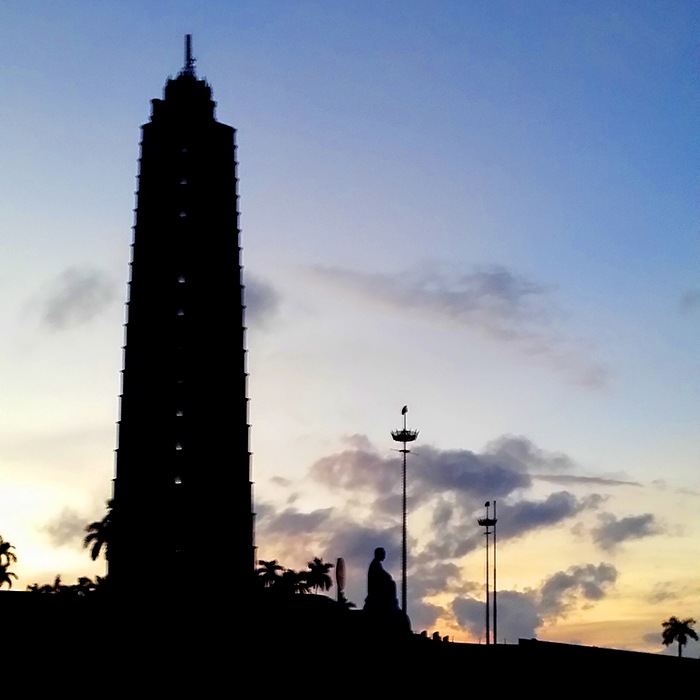
A view of a monument to Cuban hero and poet José Martí and Revolution Square at dusk. Havana, Cuba, January 2015

All things change. Just as football (the European / Latin American variety) usurps baseball as the collective national preferred sport amongst Cubans, at one point in the not-so-distant future the Castro brothers’ reign over Cuba will come to an end. What will follow is truly anyone’s guess, and largely depends on who takes over as much as US policy at the time. But, you can feel the impending shift and anticipation just about everywhere in today’s Cuba.

Our most recent trip to that most enigmatic island nation coincided with a seismic shift in the relationship between my country and my husband’s — about damn time, too. Alongside the shifting relations and perhaps more widely heralded in Cuba, this news accompanied the release of the notorious Cuban Five. Yet, that most enduring figure of communism in Cuba, so hated by most American presidents over the past 50 years—known affectionately (or not) as Fidel or El Comandante to Cubans—has remained silent.

No editorials. No public appearances. No statements released. At all.

For a guy known to give passionate speeches lasting more than three or four hours in full military fatigues at the height of the sweltering, balmy, sauna-like summer sun and heat of Cuba, this defies belief.

His silence has inevitably lead to widespread speculation and a vast array of rumours about his death, some stemming out of hope, some simply voicing questions regarding how he can possibly remain silent for so long about something so hugely important for his country, let alone the Cuban Five’s release, something he personally promised to accomplish.

But, whispers of Fidel’s (imminent) death predated the biggest news story of late last year. He has not been seen in public for more than a year, something somewhat unprecedented for a man who featured prominently almost daily in the news and public eye at one time. A year ago during that rare pubic appearance, he looked frail and rather, well, old.

Alongside this bit of trivia on the Fidel Watch Parade and perhaps a bit more alarming comes the revelation that his once prolific musings published in Cuba’s most-read newspaper have also been lacking. His last article published in Granma, the official newspaper of the Cuban Revolution, appearing in print on 13 October 2014, predating the biggest news regarding US-Cuban relations perhaps since the Bay of Pigs.

Any sane, logically thinking person would raise a few eyebrows given these observations, let alone ask a few questions regarding where Fidel is at the moment.

My first experience understanding the absurdity of Cuban state news came when announcements ran across the bottom of the TV screen that Maradona (the infamous Hand of God Argentine football player) received a letter from his friend Fidel, in which Fidel declared that he is ‘indeed still alive’. A letter? Really? To a football player with somewhat questionable ethics? M’okay. (Let’s ignore for the moment that this was typed and most likely signed with an auto-pen, and, more importantly, made no mention at all of recent events.) It wasn’t just that news of receipt of this letter was a headline, top-of-the-news programme item. That the tagline referred to dispelling the rumours of Fidel’s death left all of us witnessing it in bewildered hysterics. (By all of us, I mean my husband and his family, with whom we were visiting when the news broke.)

To further fuel speculation and the ever-expanding rumour mill, the next day, another top news story declared that Fidel’s nephew said, ‘Fidel is alive and healthy’. This particular item doesn’t appear to have made international press. Little wonder why.

Rather than quiet the whispers, talk became much louder and more frequent as news of Fidel’s letter to Maradona spread and his nephew’s statement left most laughing (and questioning) harder still.

Things do change and Fidel’s lengthy absence from Cuba’s public eye indicate something. Just what remains to be seen. The last time such speculation reached this fevered of a pitch, Fidel stepped down as president and his younger brother Raúl took on the role, another event which seemed exceptionally unlikely just weeks before it actually happened.

Since our last visit to Cuba ending in early 2010, things have changed considerably in some ways. Private traders and small businesses have sprung up everywhere. [This statement requires a very large asterisk, and deserves a post all on its own. The Cuban government published a very, very lengthy list of what types of businesses private, self-employed individuals are allowed to engage in. Almost no profession that requires advanced training (think doctors, engineers, computer programmers and the like), made this list.] Much restoration to Habana Vieja has transformed sections of the oldest parts of the city, a mammoth task funded largely by foreign development aid budgets. But, there is still much work to be done.

For all the good the Castro brothers and the 26th of July Movement accomplished in equalising opportunities for education and access to healthcare for all, the currently poor living conditions and low wages amongst just about everyone in the country leave much to be desired. Yes, goods and services are largely cheap. Yes, every citizen theoretically is given ‘access’ to basic living goods vis-à-vis the ration cards which everyone receives in Cuba and which includes things like coffee, sugar, bread, cooking oil, etc., but doesn’t provide enough to live on.

Wages, however, remain exceptionally abysmal (~US$15-25 / month). If goods and services were even slightly more expensive, no one except those earning supplemental income from the wide array of ‘grey’ or semi-black market-like activities would be able to afford them. Buildings are still crumbling whilst their inhabitants watch from within, and roads are so scarred by potholes that they often resemble obstacle courses rather than routes from Point A to Point B and may require extensive refurbishment to suspension systems if taken on at speeds to high. Trash is seldom picked up from bins in the poorest neighbourhoods, left to overflow onto the surrounding streets and picked up only partially after strewn about and becoming too unwieldy.  One friend lamented this reality in his own neighbourhood, explaining that the trash is only removed after it becomes so plentiful that it takes a backhoe to pick up and then destroys any bit of grass that hasn’t already been spoiled.

So, what comes next?

Raúl, in his most recent re-election to a five-year term as President, declared that he would step aside in 2018. That is soon. Exceptionally soon when you think about the decades-long rule the Castro brothers have enjoyed. Difficult times likely lie ahead for Cuba and her people. It breaks my heart in all honesty — she and her people have endured so much already. I’d like the transition to be as benign as humanly possible. Yet, I (and my husband especially) fear the path will prove bumpier than ever.

As to Fidel, based on discussions with friends and family in Cuba, some think that he may have already died and no one knows quite how to announce it. More probable and highly plausible is a scenario which has rendered Fidel completely incapacitated in a persistent vegetative state hooked up to life support with no one willing to pull the plug. Consensus suggests that such a cognitive state made it possible for the thawing of relationships between our two countries, and those at the highest political levels in Cuba felt it was better to create a healthy relationship with its largest and nearest foe before news of Fidel’s demise is announced, whether it be his death or something near-death.

Like all good conspiracies, this makes sense. But, Fidel has defied odds on multiple occasions before. Personally, I’m not holding my breath, just as I’m sure others are reluctant to do. Who knows what’s up with or where Fidel is. One thing is for sure though — someone will replace Fidel and Raúl in three years’ time.

Until then, let the rumours continue.