
Where an ‘I love you’ text is a crime

A week ago, a man in Cameroon died. Roger Jean-Claude Mbede, who was only 34 years young, died of complications and lack of treatment for a hernia. As if this wasn’t tragic enough, Roger died needlessly and senselessly after having to live in hiding and knowing that his family wanted to remove the ‘curse’ which plagued him. Why?

Because he was gay.

Roger was jailed under Cameroon’s anti-gay legislation in 2011 for sending a text message to a man which read, ‘I’m very much in love with you’. He was sentenced to three years in prison, and later released on medical grounds. He lived in hiding upon release and some reports suggest he was barred from receiving medical treatment. Even his family said that it would be better to just let him die.

Because he was gay. Because he loved a man and declared that love.

There are far, far too many countries in which individuals who do not fit the ‘norm’ face criminal charges for simply declaring an emotion which should bring joy, happiness and hope. Depending upon how you classify both country and legislation, a total of 83 countries (84 if you count Russia) have laws which place strict limitations on the human rights freedoms to those citizens who are gay, lesbian, bi-sexual and transgender. That’s 84 too many. Imagine living in a place where you cannot declare your love for another human being. Where you cannot show your love for another human being. Where you are not free to love and show that love for whom you wish.

With all of the attention Russia and President Putin have been quite rightly getting given the upcoming Olympic games, perhaps we can also shine a spotlight on all those other countries in which LGBT men and women face prison, discrimination and stigma on a daily basis simply for being who they are. This includes Cameroon, Nigeria, Uganda and 35 other African nations (although the Ugandan law has not been signed by the president as of this morning). These are only the countries from one continent in which laws exist making it a crime to be gay. Let’s not forget the Americas, Asia, and, yes, Europe. As we in the developed North applaud the steady march towards marriage equality in the United States, the spread of laws which criminalise homosexuality continue and with them stigma, discrimination and hatred become more common and, in a way, legally sanctioned and institutionalised.

Despite Putin’s claims that the Sochi games will be welcoming to all athletes and free of discrimination in any form, what about the remainder of Russia outside the Olympic bubble? Actions, and in this particular case, legislation speak infinitely louder than words. So loud in fact that 27 Nobel laureates and Sir Ian McKellen (aka Gandalf) have penned a letter asking President Putin to reconsider the anti-gay propaganda law. Once the Olympic torch is extinguished, I’m dubious that anything will change, and suspect that things for Russia’s LGBT community may in fact become more grim.

But, what of those other countries in which the laws are even harsher? What of those countries who punish their LGBT citizens with decades long or even life prison sentences? What of those countries where being gay carries the death penalty? Where is the outrage? Where is the international support? Where are the protest letters from those 27 Nobel laureates and knighted actors?

In some parts of the world, undoubtedly we’ve come a long, long way towards making it safe and legal for all to love whom they love, openly and without fear (or, as it should be). But, as the senseless and tragic case of Roger Jean-Claude Mbede illustrates all too cruelly, we still have a very long way to go.

The Anti-Gay World (pinched from Buzzfeed)

The Anti-Gay World
(pinched from Buzzfeed)
Come on, Texas. Really?

I’ve written before about my connection to that most unique state, Texas. Today’s post sadly isn’t one which fills me with state pride.

Since seeing the tragic news a few days ago about Marlise Munoz, a 33-year-old brain dead woman who is forcibly being kept alive to serve, quite bluntly, as an incubator, has me speechless. Ms Munoz by all accounts is unable to live without full life support and will not recover. Her husband and parents want to take her off of life support and have wished to do so since learning that there is no brain stem activity. She herself had previously said that she did not want to be kept alive in a vegetative state. So, why is she now on life support against the wishes of her family and her own living will?

She was 14-weeks pregnant when she collapsed.

In Texas, life-sustaining treatment can not be withdrawn or withheld from a pregnant woman regardless of how far along she is in her pregnancy. As of 2012, similar strict laws surrounding end-of-life care for pregnant women existed in 12 states in the US, according to a 2012 study by the Centre for Women Policy Studies. (These states are Alabama, Idaho, Indiana, Kansas, Kentucky, Michigan, Missouri, South Carolina, Texas, Utah, Washington, and Wisconsin.) Thus, even if an advance directive exists stipulating that a woman does not wish to remain on life support if she is considered brain dead, the state has the right to keep her on life-sustaining support if she is pregnant. Her wishes for a dignified death are unimportant and she is essentially rendered an incubator. This is precisely what has happened to Ms Munoz.

Had she been further along in her pregnancy, I might find this more understandable. But, she was still in her first trimester when she was classified as ‘legally’ dead. She suffered from a lack of oxygen for an extended period of time, which most likely also affected the foetus. But, nevermind that.

What really gets me is the medical bills. Since it is the hospital’s decision to keep Ms Munoz on life support , you would think that the costs would fall on the administration. No. The bills will ultimately go to her family. With an average cost of US$4004 per day, already the bill is quite steep (~US$170 000 already at least). And, that’s just for the intensive care unit bill. But, this does not necessarily include the costs of the ambulance, emergency room and other various services and service providers, specialists, etc. undoubtedly used since she first collapsed on 26 November. All of these add to that already hefty bill and in the absence of a national healthcare system. For what?

My understanding is that, currently, the hospital is waiting until the foetus has developed further to determine if they will keep Ms Munoz on life support further and what additional actions they will take. Should tests reveal that the foetus is brain dead, what next? Who will be responsible for providing long-term care to that foetus/infant? The family? Or the hospital? Or the state of Texas?

Without delving into the pro-life / pro-choice debate, this case in particular fills me with sadness for the family of Ms Munoz, but also for Ms Munoz herself. Her dignity as a human and as a woman specifically has been diminished so greatly. She expressed her wishes to not be put on life support should she lose brain function. Her wishes have been ignored completely all for the sake of a foetus which may or may not survive to birth, and may or may not itself be brain dead.

In the words of her father, she is a ‘host’ at this point, not a woman or a mother. In cases like this, it’s hard to see that women are valued within society as anything but incubators when the rights of a foetus are placed so clearly above those of the mother. And, if we can fight so fiercely for the well-being of a foetus before it enters the world, why do we not then provide that same level of care and concern for the child it becomes?

Clearly, medical technology has advanced at an amazing rate, so much so that the ethics of our options have not completely sunk in and we have yet to philosophically ponder let alone come up with solutions / answers which work for all of us given our varied beliefs and moral compasses. Yet, I would hope that we would at the very least put the dignity of an individual, especially when spelled out when one is capable of still making such decisions, above all else.

For now, my thoughts are with the Munoz family. Suffering such a loss is bad enough. Having to relive it each and every day in such a viscous, callous and myopic way is unthinkable. May they be able to finally and definitively grieve sooner rather than later.

Forgive us, Ike

I am no supporter of Bashar al-Assad, nor do I support the use of chemical weapons of any kind. In fact, I’d rather see a world free of conflict entirely. Pipe dream, yes, and one I’ll gladly continue to puff on in my little idyllic world.

But, I’m amazed (and more than a little outraged) that a mere 10 years after we watched Sec of State Colin Powell present now-understood-to-be false information to the UN on the existence of fictitious WMDs to justify a war in Iraq which should never have been, President Obama is seeking support for air strikes against Syria and Assad. Air strikes, which some argue would support a ‘group’ the US is more or less in a prolonged war against in that oh-so-crystal-clear War on Terror — aka al Qaeda. Strikes which some warn would launch the region which is already on tender hooks into utter chaos and unleash cross-border international instability.

What’s even more shocking is the incredibly quick show of support President Obama received from the likes of Speaker of the House John Boehner and Representative Eric Cantor, two men who have made the sole purpose of their political lives to thwart any and all policies the President supports and have sought to cut any all spending related to, say, helping the American public. That is, any spending not directly related to defense.

Seriously?!

Never mind that air strikes are aimed at a region of the world which is far more complicated than sound bites and 60-s news cycles can describe and do justice to. Nor that this is a region where the US is not exactly a ‘friend’, except if you speak to Israelis. Syria’s history is long and varied. And, its current civil war is multifaceted and steeped in history. Other than responding to the red line that was chemical weapons use by Assad’s government forces, what are we thinking?

President Dwight D Eisenhower, a Republican, must be screaming at us from his grave. And, he’d be quite right to do so. In his address just prior to leaving office in 1961, he warned:

In the councils of government, we must guard against the acquisition of unwarranted influence, whether sought or unsought, by the military industrial complex. The potential for the disastrous rise of misplaced power exists and will persist. We must never let the weight of this combination endanger our liberties or democratic processes. We should take nothing for granted. Only an alert and knowledgeable citizenry can compel the proper meshing of the huge industrial and military machinery of defense with our peaceful methods and goals, so that security and liberty may prosper together.

Where can we find an Eisenhower for the 21st century to stand in opposition and as the voice of reason against our current path towards that increasing complex which has already had dire consequences for yet another generation of young men and women who serve their countries in senseless wars? Where can we find leaders who will allow us—the citizenry—to question their decisions, review their actions, and hold them accountable without fear of persecution, particularly when military interests far exceed the needs of the American public?

Things were not much better for Eisenhower early in his presidency. Writing to his brother in 1954, he had this to say about some of his Republican contemporaries:

Should any political party attempt to abolish social security unemployment insurance and eliminate labor laws and farm programs you would not hear of that party again in our political history. There is a tiny splinter group of course that believes you can do these things. Among them are a few other Texas oil millionaires and an occasional politician or business man from other areas. Their number is negligible and they are stupid.

You could replace ‘Texas oil millionaires’ with ‘Midwestern industrialists’ and you wonder if Eisenhower didn’t have a crystal ball. Sadly, however, their numbers are not so negligible today and any Eisenhower-type Republicans are largely missing from American politics.

I’m not saying that Eisenhower is without flaws. Far from it. But, today, we repeatedly hear there is no money for unemployment benefits or job training programmes, improving social services for those most in need and downtrodden, there has been precious little done to help boost or put forth a jobs bill, and the House of Representatives has voted 40 times to repeal a law which is already on the books and attempts to make health care more accessible to all.

Yet, let’s go to war again. Why not? Iraq only cost about US$820 billion (and counting). Sure! And, look at how much better things are for the Iraqi people now?!

Forgive us, Ike. We know not what we do.

Or, more aptly, we do know, and we simply don’t care. We have become slaves to the military-industrial complex and we should have heeded your warnings.

From deviantart.net

From deviantart.net

Can you afford to be sick?

The debt ceiling ‘debate’ (although debacle seems more appropriate) has spurred many to trumpet the importance of cutting all spending, regardless of what that spending is on. Surprisingly, rather than focus on the most wasteful and senseless spending—fighting at least three wars which are resounding multi-year and multi-administration failures (e.g., Afghanistan, Iraq and the War on Drugs)—most of the discussion has focused on slashing the limited social protections we have in the US system.

I’ve long been a supporter of healthcare reform in the US and worked as an activist in the early 1990s to drum up awareness of the push for a national healthcare system for all Americans at a time when it was only just gaining momentum. It surprises me still how vehemently against a national healthcare system most Americans are even though they have witnessed decreasing coverage from their policies and exponential increases in their premiums and co-payments.

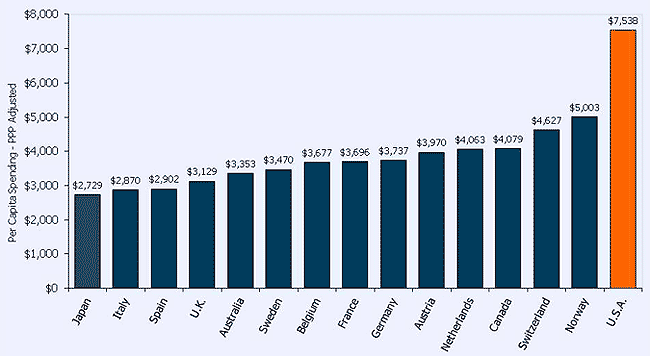
Spending per capita by country

We in the United States spend more than any other country on healthcare per captia by quite some margin. As of 2008, estimates by the Organisation for Economic Co-operation and Development (OECD) found that, after adjustments for currency and purchasing power parity, the US spent on average US$7538 per capita on healthcare. Compare that to the next highest level of spending per capita, found in Norway, at US$5003. Despite this spending, the US is just about equal to Cuba in terms of adult life expectancy (78.3 years overall for both countries). Yet, in Cuba, a mere US$260 per capita was spent in 2005 to the US$6543 spent in the US that same year.

Meanwhile, most Americans have experienced the dreaded pre-existing condition clause. That is, those individuals unfortunate enough to have been diagnosed with any sort of pre-existing condition are left without any coverage at all. I personally know more than a few individuals who will never be able to pay off the debt they owe for hospitalisations and/or treatment that potentially saved their lives. One friend has been an insulin-dependent diabetic since he was a child. He could not get insurance of any kind and rarely sought care because it was so expensive. As a consequence, he had a massive stroke at 29, experienced a prolonged hospitalisation and physical therapy, and now cannot ever hope to buy his own property given his credit rating due to the unpaid medical bills. He’s hardworking and always has been, and has even set up payment plans with all of the various providers for his stroke treatment. But, he will never enjoy the luxury of private insurance coverage.

I also know many (including myself) who have at one point in their lives gone without treatment even for minor conditions because they either could not afford insurance coverage or could not afford the co-payment.

This in a country which until recently has enjoyed unheralded wealth and one which boasts the best possible care available anywhere on the planet. That is, as long as you can afford it.

Contrast this to where I currently live—Finland. A friend of mine has the misfortune of experiencing breast cancer. She is a model of dignity and grace and bravery. It’s been a whirlwind for her and for those of us who hope to provide whatever support she and her family need to get through it. One of the eye-opening aspects of it all has been the exceptional (and incredibly timely) care she has received since her first appointment to check out a lump she found.

She was sent for an ultrasound, mammogram and biopsy within a few days of her first appointment to check out the lump. She received the biopsy results less than a week after the sample was taken. She was then scheduled for surgery straight away and had it the following week. Thus, between her first appointment and her surgery, a mere three weeks had passed. (She later found out that because of the type of cancer she has, someone else was bumped to a later date to allow them to remove her tumor more quickly, something which was key given the type of cancer she has.)

She is covered by the Finnish social benefits programme, which is more commonly known as Kela here and includes health as well as employment benefits, education, etc. Everything required for her treatment and medical bills is covered under Kela, and these benefits are the same for all residents regardless of what citizenship they hold. Her co-payments have been rather minimal. In her words, here they are:

  • ‘I paid €27.40 for my mastectomy surgery and another €27.40 for my overnight stay in the hospital!
  • My breast prosthesis, a special prosthetic bra and my hair prosthesis (wig) were all covered.
  • I’m taking a special drug to boost the production of white blood cells to make up for the ones the chemotherapy kills off. I have to take the shot each time I have a chemo treatment, and each shot costs €1300 euros! However, with a special waiver, I only pay THREE euros per shot. [NB: When she went to pickup her shot after her second round of chemo, the pharmacists suggested that she take three shots at once since they had them to hand. Thus, she paid a mere €3 for nearly €4000 worth of medications!]
  • In addition, once we’ve paid €600 out-of-pocket in a year, anything above and beyond that is fully covered.’

Contrast this to the experience of a friend hers who is in the US and also going through breast cancer. The day after her reconstructive surgery, her insurance company sent her a letter saying they would not pay for it. The day after. Can you imagine?

My friend here has not had to wait ridiculous amounts of time and has received exceptional treatment as well. It’s really quite impressive. And, as difficult of a time this is for her and her family, the experience has been somewhat less stressful because she is here and not in the US.

I know the tired arguments in the US against a national healthcare system which suggest that quality is compromised. That is patently untrue. Finland has one of the highest survival rates and treatment success rates in the world for several types of cancer. Beyond cancer, remember when David Beckham injured his Achilles’s tendon? He came to Turku, Finland, to see a particularly brilliant orthopaedic surgeon to have the tendon repaired .

I also know that many Americans baulk at the thought of their taxes being increased to pay for a national healthcare system. I don’t pay anymore in taxes here in Finland than I did in the US, and our quality of life is much better. Frankly, I’d rather my tax dollars went towards things such as improving the US education system and ensuring that healthcare was more equitable and not simply a luxury afforded by those who make enough money. Healthcare costs have been increasing for decades and will only continue to do so, largely due to the insurance industry’s stranglehold over hospitals, clinics and providers. Furthermore, we can still have private insurance and care alongside a national system, much as they do in places such as the UK and the Netherlands.

But, isn’t ensuring that all Americans have access to preventative as well as life-saving treatment and care regardless of their social, economic or political background a much better way to spend our tax revenue? Is it not more equitable and just? Would you not want to have that care for yourself or a loved one should you have an illness?

‘And I am the Drug Policy Alliance’…

I’m often quite happy to miss the ‘news’ on main stream television, particularly when I read of interviews and exchanges such as the recent ‘debate‘ between Fox News and the Drug Policy Alliance.

The Alliance has just released a rather poignant video highlighting the need for a rational, evidence-based and research-informed approach to drug policy. Rather than focusing our efforts and resources on criminalisation and incarceration, we should re-focus our attention on a human-rights based approach to drug use and policy. I fully embrace this approach, which is not at all surprising given what I do for a living.

A smattering of viciousness and derogatory language from Mr O’Reilly and his co-host Megyn Kelly highlight their inability to understand the issues at stake and how damaging and unhelpful the so-called ‘War on Drugs’ has been and remains.

Thus, the message in the Drug Policy Alliance’s latest video was completely and utterly lost on them. In addition, their segments (three, that I could find) were not based on intelligent debate, but on rhetoric and unsubstantiated claims, many of which are simply false.

Drugs have been legal and regulated in several countries to varying degrees for many years now. I spend about 25% of my time in the Netherlands these days, and there is very little in the way of ‘drug-related crime’. In fact, within the last year or so, I was told by Dutch that the state was forced to close prison facilities because they did not have enough prisoners to fill them. That is, prisons were sitting empty rather than bursting to capacity such as those in the US. Think about that for a moment.

John Stossel, also from Fox News, quite rightly made the point to Mr O’Reilly that prohibition drives the behaviour underground. Indeed. The prohibition of drugs has worked much the same way as the prohibition of alcohol—people will find ways around the law and will go to great lengths to hide it from the authorities.

The real shame in driving behaviours underground is that even if an individual does wish to seek help for dependency or any other medical and/or social issues, they are less likely to do so if they believe they run the risk of incarceration or any sort of reprimand. Thus, any programme designed to reduce drug- or substance-related harm, such as needle-exchange programmes, are less likely to reach them. In an age of HIV, this represents a tremendous shortcoming and travesty.

I support and applaud the Drug Policy Alliance in their efforts to advocate for a human-rights based approach to drug use. And I fully support an end to the War on Drugs.