¡Chanchullo!

Below is the third dispatch from our recent holiday in Cuba, written shortly after leaving the relative isolation and ‘comfort’ of our idleness experienced during our stay at a resort in Varadero. (The first two pieces from our trip can be found here and here.)

Spending time with friends and family and in an everyday, typical Cuban home and various neighbourhoods long the way were probably the best elements of our journey.  As we return to our exceedingly quiet and work-filled lives back in Helsinki, all of the various images and sensations this post conjures but which were not captured on film are missed immensely.

~~~~~~~~~~~~

Cuba, particularly compared with life in Finland, is loud and unpredictable. As a place, she is vibrant and somewhat akin to organised chaos to put it exceedingly simply. At moments, I find it completely overwhelming, and following everything happening around me can be nearly impossible, especially since my Spanish is virtually non-existent. In spite of my need for solitude most mornings and at various times throughout the day as well as my obsessive-compulsiveness about well-laid out plans and agendas, the go-with-the-flow reality of life in Cuba exhilarates and thrills me. In a very odd way and more so than most other places I’ve visited, Cuba also refreshes me.

There is a word for this seemingly difficult-to-capture ever-present state in Cuba which is part chaos, part angst, part unpredictability: chanchullo.

Trapped here without access to the internet (since I’m writing this sat in my cousin’s flat in Alamar), I’m desperate to look up various words to add to my expanding Cuban-Spanish lexicon, many words I forget as quickly as I become cognizant of them. This word, however, will stick. It’s perfect for all the sounds and movements around me.

Image a scene in a house filled with constantly busy hands; non-stop chitchat about what to buy, what needs to be fixed, how to organise transport to get from Artemisa to Altahabana, and who needs/wants coffee or pan del Comandante (El Comandante’s bread, which is what most Cubans use to refer to the bread ration received) with or without mantequilla (butter). On the street just outside, the most recent vendor (from the endless stream of them who make an appearance throughout the day) strolls through the street whistling and yelling, ‘¡Panadero!‘, indicating that he has bread (which may or may not be fresh). In a nearby flat, a mother and daughter may also be heard arguing with one another about whatever with an increasing intensity and volume, as all of the neighbours listen.

This sums up chanchullo. The important component is that everyone understands and is aware of all elements at once.

I love this. More so, I love that I’m beginning to understand an increasing amount of the chaos. My family—delighting in my understanding and affection for the term after introducing me to this fabulous word—now revels in labelling me a chanchullera, as far as I can determine a lover or bringer of chaos, which, I must admit, fits to a certain extent. A verb form of chanchullo also exists, which will be one of the first verbs I learn as I begin the journey towards fluency in Cuban-Spanish, something I’m also desperately committed to realising.

I still steal a few moments of solitude each day. But, those moments are fewer and further between, and their form has altered considerably as the weeks have passed. Mostly, in my desire to keep up and pay attention, I need those few moments to catch my breath. Then, I can dive back in to chanchullo and enjoy the beauty that is Cuba and her people.

As a footnote, one of the first things my husband introduced me to upon our return to the land of 24/7-internet access was the song and entire album dedicated to chanchullo from one of my favourite Cuban musicians Ruben Gonzalez. If I’ve learned anything from the Cubans in my life, it’s this: sometimes, it’s just easier to embrace the chanchullo. You may just find that you like it.

Third time’s charm

For those not in ‘the know’, my husband and I spent six glorious weeks on holiday in Cuba, visiting family, finally enjoying a long-overdue bit of rest and relaxation (first time in five years!) and catching up with friends. This was our third journey to the island together. But, it was by far the most amazing experience of the three and perhaps of any other trip I’ve taken. The following represents a few reflections I wrote about a week or so before we left.

~~~~~~~~~~

This trip.

Summing it up in a single word is impossible; describing it all seems just as unlikely.

From its length to its particulars, the journey has not altered too significantly from previous visits. As it draws to a close, I’m longing to extend it. Not so much to escape our real lives in Finland longer, but because I am enjoying this trip so, so thoroughly.

A few days ago, we visited Cojímar, the fishing village which served to inspire The Old Man and the Sea, and then visited Hemingway’s villa Finca Vigía in what was once the countryside surrounding Havana. Having recently reread that incredibly epic fishing tale and The Sun Also Rises a few weeks previously, I felt as if I was walking amongst ghosts, both of the fisherman Santiago and Hemingway himself.

Cojímar is quiet, tranquil and carved by the sea, situated not far to the east of Havana. On the day of our visit, the seas were angry in the wake of a cold front the night before. Ocean spray coated us as we walked along the streets nearest the water, with water crashing into the rocky, coral-laden coastline. A tour bus made its way carefully and slowly through incredibly narrow and pothole-filled streets whisking other tourists away with it, while the locals ambled through the village in groups of varying ages. We strolled through the village with no real destination in mind, waving to and chatting with inhabitants, buying various products from the local produce vendors, having a laugh with just about everyone we met and enjoying the calmness and normality of it all. I can see why Hemingway was inspired — Cojímar and most of Cuba inspire me.

The next day, we visited Hemingway’s Cuban estate, Finca Vigía, which has been kept in the same state in which he left it more than 50 years ago. We (my husband, our three cousins with whom we spent the day and I) flagged down an almendrón, one of the old 1940 and 1950-era American cars which have carted Cubans to and fro for decades now and which everyone associates with contemporary Cuba. Our driver, Ernesto, ended up being another element of surprise and delight, one of many from this trip.

As we made our way to Hemingway’s home, one of the overwhelming realities hit us head-on. Much of the area surrounding his estate sprang up long after he left the island for the last time. Now nestled within a poorer barrio, houses are clustered close together and most appear barely finished, or rarely tended or repaired. Extreme poverty prevails in this part of Havana, and crumbling structures represent the norm. Most of the houses we passed, which were clearly inhabited, would probably blow away in even the weakest of storms. Amongst this, Hemingway’s house and the surrounding estate appear as if an oasis or mirage and seem horribly incongruous with just about everything around it. The contrast was stark and somewhat artificial and arbitrary.

The Finca Vigía grounds must have provided solace and serenity — the place is incredible and unbelievably beautiful. Much like Cojímar, it is peaceful and tranquil. Compared to the chaos and noise of Havana and the area in the estate’s immediate vicinity, it seems somewhat unreal. Anyone would be able to write there. With a stunning view of Old Havana in the distance, particularly spectacular from his writing altar nestled in a panoramic tower skimming the treetops, I imagine he must have been completely and happily at ease. Honestly, I’d love nothing better than spending a week or two there myself, let alone a few years or a lifetime. Indeed, many of the photos of him at Finca Vigía show a completely content man.

As we were leaving, a hummingbird fluttered about and landed in its nest just above the steps leading up to his front door. What a perfect parting image to have in mind as we left. At least that’s what I thought at the time.

However, we ended up driving out of the estate the wrong way and again passed a few of the poorest houses along our route and surrounding his estate. The difference between Finca Vigía and the area around it is starker after spending a bit of time there — think of the most opulent luxury and then compare that to something akin to the worst sort of lesser-developed slums. It felt like traveling from a palace to a favela in an instant. Anyway, as we left the gates of his estate and passed along these poorer homes, one woman, who now as then seemed ageless, was walking out onto her front stoop looking as beaten and downtrodden as anyone I’ve ever seen. My husband and I made eye contact with her and waved as we drove by. The transformation of her face took our breath away as she waved back at us. I’ve never seen a face as electrified and brightened so quickly and easily with a smile that dazzled as brilliantly as the clearest of diamonds. I don’t know that I ever will again. But, it touched me beyond words. It still does.

Later, as we left Ernesto, our trusty driver for the day, who also immensely enjoyed Hemingway’s house, we were again touched by the generosity and kindness of individuals who struggle daily to just get by. Despite knowing that we are the ‘wealthy’ foreigners, he demanded that we phone him to drive us to the airport when we leave Cuba to return to Finland. It wasn’t so much that he wanted the 30 or so CUCs (roughly US$30) he’d make from the fare, a sum of money that most Cubans struggle to make each month. In fact, he said he’d refuse payment of any kind from us. He just wanted to drive us for our last ride before returning to the frozen North.

It’s experiences like these that provide a different flavour to our journey this time. It’s not so much that we haven’t met lovely people before. We do every time we visit Cuba. It’s just that this trip has been somewhat less filtered. Whilst we have done touristy things, we have done them more like Cubans would and experienced them with those who live within that embargoed land every day. We’ve spent less time isolated from the every day Cuba, I guess. And, it is a far, far richer place than I’d ever imagined possible for a place that is desperately poor.

I’m fortunate to have an incredibly kind and witty family with whom we can share these experiences. Not at all surprising I’m sure to anyone who has met and knows my husband. But, kindness and wittiness surround us in the most unlikely places, from the folks we pass and talk to randomly on the streets to the mad almendrón drivers who’ve carted us around.

We can only hope that we return that kindness as effortlessly as it has been given.

This slideshow requires JavaScript.

Fevered pitch

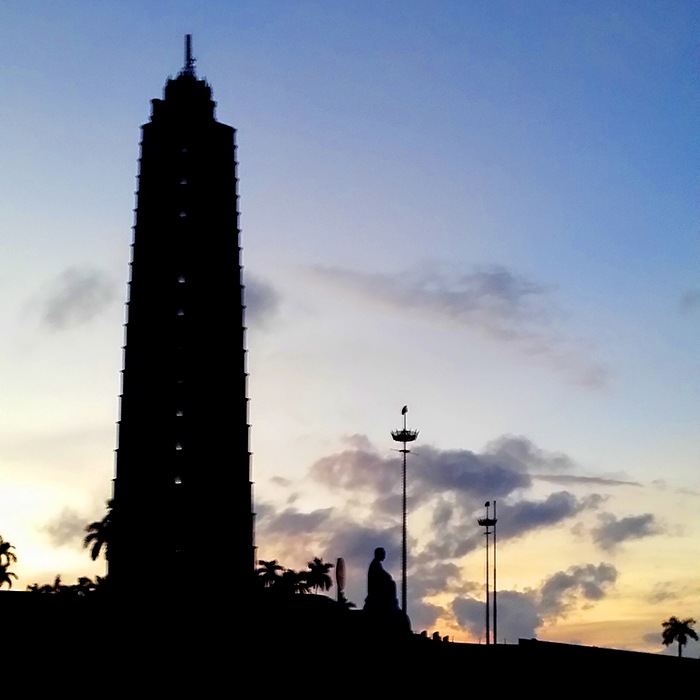
A view of a monument to Cuban hero and poet José Martí and Revolution Square at dusk. Havana, Cuba, January 2015

All things change. Just as football (the European / Latin American variety) usurps baseball as the collective national preferred sport amongst Cubans, at one point in the not-so-distant future the Castro brothers’ reign over Cuba will come to an end. What will follow is truly anyone’s guess, and largely depends on who takes over as much as US policy at the time. But, you can feel the impending shift and anticipation just about everywhere in today’s Cuba.

Our most recent trip to that most enigmatic island nation coincided with a seismic shift in the relationship between my country and my husband’s — about damn time, too. Alongside the shifting relations and perhaps more widely heralded in Cuba, this news accompanied the release of the notorious Cuban Five. Yet, that most enduring figure of communism in Cuba, so hated by most American presidents over the past 50 years—known affectionately (or not) as Fidel or El Comandante to Cubans—has remained silent.

No editorials. No public appearances. No statements released. At all.

For a guy known to give passionate speeches lasting more than three or four hours in full military fatigues at the height of the sweltering, balmy, sauna-like summer sun and heat of Cuba, this defies belief.

His silence has inevitably lead to widespread speculation and a vast array of rumours about his death, some stemming out of hope, some simply voicing questions regarding how he can possibly remain silent for so long about something so hugely important for his country, let alone the Cuban Five’s release, something he personally promised to accomplish.

But, whispers of Fidel’s (imminent) death predated the biggest news story of late last year. He has not been seen in public for more than a year, something somewhat unprecedented for a man who featured prominently almost daily in the news and public eye at one time. A year ago during that rare pubic appearance, he looked frail and rather, well, old.

Alongside this bit of trivia on the Fidel Watch Parade and perhaps a bit more alarming comes the revelation that his once prolific musings published in Cuba’s most-read newspaper have also been lacking. His last article published in Granma, the official newspaper of the Cuban Revolution, appearing in print on 13 October 2014, predating the biggest news regarding US-Cuban relations perhaps since the Bay of Pigs.

Any sane, logically thinking person would raise a few eyebrows given these observations, let alone ask a few questions regarding where Fidel is at the moment.

My first experience understanding the absurdity of Cuban state news came when announcements ran across the bottom of the TV screen that Maradona (the infamous Hand of God Argentine football player) received a letter from his friend Fidel, in which Fidel declared that he is ‘indeed still alive’. A letter? Really? To a football player with somewhat questionable ethics? M’okay. (Let’s ignore for the moment that this was typed and most likely signed with an auto-pen, and, more importantly, made no mention at all of recent events.) It wasn’t just that news of receipt of this letter was a headline, top-of-the-news programme item. That the tagline referred to dispelling the rumours of Fidel’s death left all of us witnessing it in bewildered hysterics. (By all of us, I mean my husband and his family, with whom we were visiting when the news broke.)

To further fuel speculation and the ever-expanding rumour mill, the next day, another top news story declared that Fidel’s nephew said, ‘Fidel is alive and healthy’. This particular item doesn’t appear to have made international press. Little wonder why.

Rather than quiet the whispers, talk became much louder and more frequent as news of Fidel’s letter to Maradona spread and his nephew’s statement left most laughing (and questioning) harder still.

Things do change and Fidel’s lengthy absence from Cuba’s public eye indicate something. Just what remains to be seen. The last time such speculation reached this fevered of a pitch, Fidel stepped down as president and his younger brother Raúl took on the role, another event which seemed exceptionally unlikely just weeks before it actually happened.

Since our last visit to Cuba ending in early 2010, things have changed considerably in some ways. Private traders and small businesses have sprung up everywhere. [This statement requires a very large asterisk, and deserves a post all on its own. The Cuban government published a very, very lengthy list of what types of businesses private, self-employed individuals are allowed to engage in. Almost no profession that requires advanced training (think doctors, engineers, computer programmers and the like), made this list.] Much restoration to Habana Vieja has transformed sections of the oldest parts of the city, a mammoth task funded largely by foreign development aid budgets. But, there is still much work to be done.

For all the good the Castro brothers and the 26th of July Movement accomplished in equalising opportunities for education and access to healthcare for all, the currently poor living conditions and low wages amongst just about everyone in the country leave much to be desired. Yes, goods and services are largely cheap. Yes, every citizen theoretically is given ‘access’ to basic living goods vis-à-vis the ration cards which everyone receives in Cuba and which includes things like coffee, sugar, bread, cooking oil, etc., but doesn’t provide enough to live on.

Wages, however, remain exceptionally abysmal (~US$15-25 / month). If goods and services were even slightly more expensive, no one except those earning supplemental income from the wide array of ‘grey’ or semi-black market-like activities would be able to afford them. Buildings are still crumbling whilst their inhabitants watch from within, and roads are so scarred by potholes that they often resemble obstacle courses rather than routes from Point A to Point B and may require extensive refurbishment to suspension systems if taken on at speeds to high. Trash is seldom picked up from bins in the poorest neighbourhoods, left to overflow onto the surrounding streets and picked up only partially after strewn about and becoming too unwieldy.  One friend lamented this reality in his own neighbourhood, explaining that the trash is only removed after it becomes so plentiful that it takes a backhoe to pick up and then destroys any bit of grass that hasn’t already been spoiled.

So, what comes next?

Raúl, in his most recent re-election to a five-year term as President, declared that he would step aside in 2018. That is soon. Exceptionally soon when you think about the decades-long rule the Castro brothers have enjoyed. Difficult times likely lie ahead for Cuba and her people. It breaks my heart in all honesty — she and her people have endured so much already. I’d like the transition to be as benign as humanly possible. Yet, I (and my husband especially) fear the path will prove bumpier than ever.

As to Fidel, based on discussions with friends and family in Cuba, some think that he may have already died and no one knows quite how to announce it. More probable and highly plausible is a scenario which has rendered Fidel completely incapacitated in a persistent vegetative state hooked up to life support with no one willing to pull the plug. Consensus suggests that such a cognitive state made it possible for the thawing of relationships between our two countries, and those at the highest political levels in Cuba felt it was better to create a healthy relationship with its largest and nearest foe before news of Fidel’s demise is announced, whether it be his death or something near-death.

Like all good conspiracies, this makes sense. But, Fidel has defied odds on multiple occasions before. Personally, I’m not holding my breath, just as I’m sure others are reluctant to do. Who knows what’s up with or where Fidel is. One thing is for sure though — someone will replace Fidel and Raúl in three years’ time.

Until then, let the rumours continue.
‘No more boundaries; no more borders’…

The Two of Us

The two of us on holiday in December 2009.

I’ve been thinking a lot lately about borders and passports and documents.

The words of the late, great ‘Doctor’ Remmy Ongala fill my thoughts and best express them—the idyllic and unrealistic image of a world without passports, border controls and immigration officials.

The Cuban and I live in a world which is very much predominated by worry and fear of the unthinkable. We live in a country which is not our own. And, we live in a world which is focused on pieces of paper and an unimaginable pile of documents and endless applications. We are dependent upon one another for those documents which allow us to not only live in a specific country, but to continue our life together. The hard truth and knowledge that at the whim of any one bureaucrat we may be forced to abandon that life together fills our hearts and minds with an unspeakable fear.

Our crime? Falling in love with an individual from a country which our respective governments consider personae non grata.

I recently read an article about the horror faced by couples in the US in which one partner is either detained awaiting deportation or has already been deported. That is, families—real, loving families—have been ripped apart because of the decisions of others with only the specifics on a bundle of paperwork to guide them. it is unfair, unjust and unconscionable, particularly in a society which prides itself on ‘family values’.

Much of the discussion surrounding immigration reform in the US removes the context and nuances faced by individual couples. This has certainly been our experience both within and beyond the borders of our own respective countries. Yet, those specific details are what make individual cases so incredibly real and rich. And, heartbreaking. Most decisions are based on an inventory of checked boxes. When neither box applies, decisions are taken with no thought or closer examination of the individuals affected. Rarely do the consequences of those decisions warrant much attention or reflection, and therein lies the tragedy.

As The Cuban and I move through the incredibly frustrating and murky bureaucratic maze in our attempt to continue our life together, we still hope for and dream of a world in which passports, borders and immigration officers retain a bit of human compassion. We all inhabit one world.

Happy World Environment Day 2010

The United Nations Environment Programme celebrates World Environment Day on 5 June this year.

The idea behind WED is to ‘celebrate positive action for the environment’. Tree plantings and naming baby gorillas provide Rwandans with an opportunity to celebrate their country’s rich ecological niche. Bahrain organised a Cultural Environment Week which folds in nicely as a part of the International Year of Biodiversity. Arts and essay competitions along with photo exhibitions have been combined in many countries with invitations extended to local artisans to create works that focus on biodiversity and the ecological riches found the world over.

Contrast the idea of WED to the travesty occurring in the Gulf of Mexico at the moment.

An oil-covered brown pelican found on the Louisiana Coast on 4 June 2010. Photo by Win McNamee/Getty Images, reposted from The Huffington Post.

A few days ago, new images of pelicans and other seabirds, dead fish and dolphins appeared, all of which were covered in oil from the Deepwater Horizon oil spill. The images were vile and stomach-churning to say the least. I’ve seen a few news items within the past few weeks where some claim that the impact on the eco-system surrounding the spill won’t be impacted too badly. The damage won’t be ‘that bad’.

My question to those who make such claims is this: what do you consider ‘not that bad’?

There are so many things about the tragedy in the Gulf that impact those beyond the workers on the platform or the company (-ies) losing precious cash. Those who live in the Gulf will be perhaps impacted the most—from the fishermen who benefit from the delicate eco-systems to those who work in the tourism industry in a region of the US that is amazingly beautiful. With news that the Gulf currents could extend the effects of the spill up the Eastern seaboard and beyond, another place close to my heart could also be profoundly impacted—Cuba. If it took the area effected by the Exxon Valdez oil spill 30 years to recover, how long will it take the Gulf? And, is the immediate pay off worth the sacrifice?

Our—Americans’—reliance on oil is and has been gluttonous. On World Environment Day, shouldn’t we consider the impact of that gluttony and move towards less detrimental means of enjoying our way of life?

The Ultimate Go-Go Juice

Give me intravenous coffee as an alarm -- the perfect alarm clock.

As I opened up my various daily news sources, I had to chuckle when this headline and the associated image at alternet.org popped up. Intravenous coffee as an alarm clock has long been my idea of the perfect gift/gadget.

I love coffee. It’s taste. It’s smell. The various ways in which you can brew it. And, most of all, I love the varieties. I’m a bit of a snob in some ways in that my perfect cup of joe is a fresh dark roast finely ground just minutes before brewed. Most days, I’ll take whatever I can get as long as it is extremely strong and a rich dark roast.

As an undergraduate in Atlanta, I’d normally start the day with an entire pot of coffee. At the time, hazelnut was my preferred flavor (can’t stand it anymore). I had this huge 32-oz coffee mug that I’d carry with me throughout each day during classes. I’d run to the commissary in between classes to fill it up. At the peak of my consumption, the tally was shocking—something like more than 20 cups a day on average. As I said, shocking.

In graduate school both at The University of Alabama–Tuscaloosa and at The University of Connecticut in Storrs, we were fortunate to have brilliant coffee joints on or close to campus. In Tuscaloosa, the coffee shop across the strip from campus (and luckily a mere 5-minute walk from my flat) would roast their beans in-house. The smell was amazing, and the coffee matched that aroma. It was then that I realised just how yummy a fresh dark roast can be. My consumption went down, but the enjoyment of the coffee increased. My favourite cups of joe were those shared with my thesis advisor, mentor and friend, normally in the afternoon.

In Storrs at UConn, Java Joint became my daily dose source. This is where I learned what flavours I truly enjoyed. Tanzanian Peaberry. Sumatra. Ethiopian something or other. Brazilian Santos. Guatemalan Antigua. I think of them all the Sumatran and the Brazilian Santos were and still are my favourites.

Every day, I’d arrive at the little trailer which became a bigger trailer which eventually became a proper shop inside the bookstore with my more manageable thermos and have it filled with the most divine coffee. I’d usually stop in sometime later in the day in the afternoon before a seminar or office hours or a meeting with a committee member. Occasionally, the cup of joe would serve as a prop and pick me up during a peripatetic meeting with a close friend and intellectual giant with whom I was fortunate enough to work. I miss those days, and I desperately miss that coffee.

Bags of cafe de cuba from a fantastic coffee shop in Havana, Cuba.

These days, I’ll take whatever dark roast I can get. The latest great-tasting coffee to hit our kitchen is Cuban coffee. It’s subtle and lovely, and packs an outstanding kick. The Cubans in my life think anything other than a thimble’s worth of coffee is too much. I’m quite happy to enjoy two cups a day now.

That said, it’s time for that second cup.