Yes, one person can make a difference

Several years ago in a discussion with a colleague after a typical day in the office, a brief snippet of our conversation has stayed with me and inspired much reflection. Discussing the many issues in the world around us which we’d like to see change, a world more socially and economically just and fair, I declared my own desire to make the world around me just a bit better. Whether that difference be at a community or national level wasn’t important; making a difference to the lived experiences of others was what drove me, even if it was on a seemingly small scale.

His response? ‘If you help just one person, you have succeeded, no? You have after all changed the world for the better for at least one person.’

So, so simple. And, so, so true.

Both before and since that after-work conversation and revelation, I’ve thought often about what one person can do to make the world a little better. A little brighter. I’m perhaps in equal measure hopelessly naïve and optimistic enough to believe that one person can and often does make a difference. But, it wasn’t until that conversation several years ago that I stopped worrying about how many people or how large the impact was (something which my day job placed priority on — the number of people reached rather than how much better life was for one person). Yet, one person’s world is still ‘a world’. And, perhaps by helping that one person, others’ lots would improvd as well.

However seemingly insignificant the gesture may be, a single act of kindness, a random bit of support extended to another can create good. From holding a door open to buying a meal for someone who is hungry to clothing a stranger to standing up and speaking for those who have no voice, no act is too small. No act is too insignificant. And, perhaps, those changes and improvements to an individual’s ife can mushroom out as ripples on the water—one person can help another can help another and so on until an entire community benefits.

Like I said, hopelessly optimistic. (It beats the alternative!)

But, what of the more significant, larger acts? Do they take a village or can they be accomplished through the actions of an individual on his/her own?

A single person has made an enormous difference with an amazing impact, as evidenced by Jadav Payeng.

Since 1979, this one man has been planting saplings and growing a forest in Brahmaputra, India. Growing a forest. These saplings have transformed a barren, eroding landscape into a lush, green habitat for various creatures, including elephants, tigers and vultures, which returned to the region in 2012 after a 40-year absence.

Talk about seeing the forest for the trees…

If a single man can create a forest, imagine the possibilities of the seemingly small and insignificant actions we each want to do and don’t for fear it will change nothing. Just as each seed may not on it’s own create a forest, each individual action may on its own seem unimportant and carry very little benefit. Yet, over time and collectively, imagine how much better the world could be? Imagine how much better it would be?

Sometimes, it’s quite alright to focus on that individual tree.


Where an ‘I love you’ text is a crime

A week ago, a man in Cameroon died. Roger Jean-Claude Mbede, who was only 34 years young, died of complications and lack of treatment for a hernia. As if this wasn’t tragic enough, Roger died needlessly and senselessly after having to live in hiding and knowing that his family wanted to remove the ‘curse’ which plagued him. Why?

Because he was gay.

Roger was jailed under Cameroon’s anti-gay legislation in 2011 for sending a text message to a man which read, ‘I’m very much in love with you’. He was sentenced to three years in prison, and later released on medical grounds. He lived in hiding upon release and some reports suggest he was barred from receiving medical treatment. Even his family said that it would be better to just let him die.

Because he was gay. Because he loved a man and declared that love.

There are far, far too many countries in which individuals who do not fit the ‘norm’ face criminal charges for simply declaring an emotion which should bring joy, happiness and hope. Depending upon how you classify both country and legislation, a total of 83 countries (84 if you count Russia) have laws which place strict limitations on the human rights freedoms to those citizens who are gay, lesbian, bi-sexual and transgender. That’s 84 too many. Imagine living in a place where you cannot declare your love for another human being. Where you cannot show your love for another human being. Where you are not free to love and show that love for whom you wish.

With all of the attention Russia and President Putin have been quite rightly getting given the upcoming Olympic games, perhaps we can also shine a spotlight on all those other countries in which LGBT men and women face prison, discrimination and stigma on a daily basis simply for being who they are. This includes Cameroon, Nigeria, Uganda and 35 other African nations (although the Ugandan law has not been signed by the president as of this morning). These are only the countries from one continent in which laws exist making it a crime to be gay. Let’s not forget the Americas, Asia, and, yes, Europe. As we in the developed North applaud the steady march towards marriage equality in the United States, the spread of laws which criminalise homosexuality continue and with them stigma, discrimination and hatred become more common and, in a way, legally sanctioned and institutionalised.

Despite Putin’s claims that the Sochi games will be welcoming to all athletes and free of discrimination in any form, what about the remainder of Russia outside the Olympic bubble? Actions, and in this particular case, legislation speak infinitely louder than words. So loud in fact that 27 Nobel laureates and Sir Ian McKellen (aka Gandalf) have penned a letter asking President Putin to reconsider the anti-gay propaganda law. Once the Olympic torch is extinguished, I’m dubious that anything will change, and suspect that things for Russia’s LGBT community may in fact become more grim.

But, what of those other countries in which the laws are even harsher? What of those countries who punish their LGBT citizens with decades long or even life prison sentences? What of those countries where being gay carries the death penalty? Where is the outrage? Where is the international support? Where are the protest letters from those 27 Nobel laureates and knighted actors?

In some parts of the world, undoubtedly we’ve come a long, long way towards making it safe and legal for all to love whom they love, openly and without fear (or, as it should be). But, as the senseless and tragic case of Roger Jean-Claude Mbede illustrates all too cruelly, we still have a very long way to go.

The Anti-Gay World (pinched from Buzzfeed)

The Anti-Gay World
(pinched from Buzzfeed)

Suffer the Little Children

It’s hard to imagine life in Syria today. Harder still to imagine that fleeing to Iraq would be preferable to remaining in Syria.

Being a child and experiencing either is unimaginable.

Yet, Save the Children estimates that as many as 1 million Syrian children are now living as refugees. One million.

War and conflict are tragic enough. But, robbing children of their childhood and all the attendant delights of youth is simply criminal. I cannot imagine a more helpless feeling than being a parent to a child living in a war zone or fleeing from conditions which are nightmarish at best and a living horror at worst.

How do you explain it? How do you try to shield your child from the reality of war without deceiving them into a false sense of security? How do you instill hope whilst living in conditions which leave little room for belief in a brighter future?

Children under Fire, Save the Children’s report documenting the reality in which children now exist as a result of the civil war raging in Syria, is gut-wrenching.

By their estimates, more than 2 million children in Syria now need some sort of assistance. Figures from a study conducted by Bahcesehir University in Turkey which is referenced throughout the report suggest that three out of every four Syrian children have lost at least one loved one because of the conflict. Three of every four. Many children have lost multiple family members. Many of those children have watched as those loved ones died.

In their own words, children describe the horror of constant shelling and gunfire, as well as living in houses which are shelled whilst they sit inside. They describe running for their lives through neighbourhoods they used to run around in for play. They describe the loss of their schools, either to serve as shelter to the millions displaced within Syria or which have since been burned to the ground. They describe watching friends and family members being shot in front of them. One child’s mother recalled the first word spoken by her young child, born into a world lived only in a state of war: ‘explosion’. That was the first word a mother’s child ever uttered.

Malnutrition is now the norm. Children go un-vaccinated because the manufacturing of medicines has declined if not completely ceased (along with all manufacturing in the country) or because it is impossible to get through the multitude of checkpoints set up by various factions within the country. Thus, the likelihood of epidemics are all the more real. When children do get sick, it is either impossible to reach a clinic or hospital due to the continued threat of sniper-fire or bombings or the impossibility of simply getting through or there is nowhere to go because most if not all hospitals and clinics have been destroyed in a particular area.

Young girls now face the threat of sexual violence as well as the violence of war, and are thus kept indoors for weeks on end. Young boys, some as young as 8 years old, are being recruited as child soldiers and have been used as ‘human shields’.

Suffer the little children. ‘Suffer’ seems insufficient to describe the hell that is life in Syria today.

The easiest way to end the suffering is to end the conflict in Syria. As the US and others in the West beat the drums of war, peace looks unlikely any time in the near future. But, what of the children now? And, how to help even if we cannot physically be there?

In addition to prevailing upon our own leaders for peaceful solutions rather than violent retaliations, we can take steps to help in the seemingly smallest of ways.

As Syrians flee for refugee camps and as winter approaches, many of those fleeing have nothing but the clothes on their backs. One charity which is specifically designed for the crafty amongst us and focuses on helping children in need is asking for a very simple show of support and kindness—send knit or crochet squares.

LILY—or, Love in the Language of Yarn—is calling upon the community of knitters and hookers (not those hookers) to spend a bit of time busting their healthy yarn hordes to make squares, which are then pieced together and given to child refugees. As a knitter, I love this idea. As a humanitarian, it is so elegantly simple and yet necessary. As winter approaches and warm shelter, let alone a warm blanket, is often non-existent, I’ll gladly use some of my time and precious yarn stash to make as many squares as possible.

It may not be much, but it is something.

If we cannot give them security and safety, perhaps we can at least give them warmth.

Some of the squares I'll be sending in the hopes that they bring some 'security' to Syria's forgotten children living as refugees.

Some of the squares I’ll be sending in the hopes that they bring some ‘security’ to Syria’s forgotten children living as refugees.

On empathy…

My husband and I were talking yesterday about why two US Supreme Court decisions which have very little impact upon our lives meant so much to us both on a deeply personal level. He, being the incredibly poetic man that he is, quipped—‘you cry tears of joy because you have empathy’.

I don’t know if it is that, or simply that I am delighted for those individuals whom I adore who finally may marry whom they love and wish to spend their lives. That isn’t the case for every same-sex couple I know — in the US or elsewhere. But, it is slowly becoming a reality as we chip away at archaic notions of what’s right and what’s wrong. I’m not sure if my own beliefs surrounding the rights of LGBTQI stem from a sense of empathy or that there is simply nothing wrong with loving who you love. And, at the end of the day, as long as there is no lasting emotional or physical harm to either individual, it’s really no one else’s business.

But, what of empathy? What if we all worked harder to be a little more empathetic towards those with whom we only share differences?

Most likely, we’d find that we aren’t really that different and we share more than one characteristic. More than one ambition or hope overlaps even the most disparate pair. Or, perhaps, we simply talk about our differences using a language (or vernacular) which neither understands.

In my ‘day job’, an endless capacity for empathy pervades those who take up the difficult task of working with some of society’s ‘least desirable’ (as defined by some elite class). Typically, these are drug users, prisoners, sex workers, homeless, etc. Poverty, disease and an enduring suffering combined with a sense of hopelessness and self-loathing on unimaginable scales for most mortals greet many. Yet, in all of it, there is hope. There is acceptance. And, yes, there is love. We envision a world where we all are accepted and our rights as humans are acknowledged and upheld regardless of our individual circumstance. Human rights are human rights and they should be granted and accessible to all. That is, I don’t think anyone takes up this work without the understanding that, at the end of the day, we are all equal individuals entitled to the same opportunities and chances to fulfill our dreams. It doesn’t matter what label you attach to us; we’re all just people. We are all worthy.

Personally, I’d like to think that my own capacity for empathy helps shape all of my actions, both as an individual and in what I do for a ‘living’. I know that this isn’t the case for everyone nor is it a reality in my little utopian existence. Likewise, there is some debate about how much empathy may aide us in making the world that little bit better.

Whether its naivete, idealism or simply a pipe dream, there are moments when I am less empathetic to others, and that is something which I’ll strive to change. It may help. It may not. But, it certainly doesn’t hurt anyone to try it out.

Calling out prejudice

We live in a relatively quiet little residential neighbourhood, filled with families who largely keep to themselves. The neighbourhood features two bus routes running through it and a small little shopping centre, along with schools, playgrounds and parks throughout. It’s not in the city centre, but close enough to not be in the ‘sticks’. It’s a fairly typical Finnish neighbourhood as far as we can tell.

Today, my husband looked out the kitchen window to see a couple of gentlemen obviously trying to get into their car after locking their keys inside. The car was parked just across from our building on the main road running through our neighbourhood. They were not being furtive, did not look suspicious, and certainly didn’t look to be hiding what they were doing.

A little while later, he was horrified to see not one but two police cars surrounding the car and gentlemen. Why? Most likely, simply because the gentlemen were black.

Anyone could have seen immediately had they cared to that these gentlemen were not simply trying to steal the car. For one, it didn’t seem particularly theft worthy (e.g., several newer cars were parked on either side of it!). In addition, this didn’t happen during the dead of night, but in the middle of the day. That isn’t to say that thefts don’t happen during the middle of the day. But, they guys were in no obvious hurry. Buses and cars and people are traversing the route upon which the car was parked. Finns may keep to themselves, but I doubt they’d turn a blind eye to an obvious car theft. This was obviously not an attempted theft.

Using the infamous coat hanger / wire trick to get at the locking mechanism, laughing and smiling whilst doing so, these men posed no threat to anything other than their car’s own paint job. Maybe, had the person who felt it necessary to phone in to the police stopped to observe the demeanor of those gentlemen rather than to simply note their skin colour, the two police vans called to our neighbourhood could have spent their time more effectively fighting crime.

I wonder, would they have called the police had those gentlemen been white? Would they have given them a second glance?

(Addendum: The gentlemen did get their car door open and were happily on their way once they got the doors open. No windows or locks were broken in the process.)

Misogynist 0; Activist 2

Yes, we are useful.

We’ve recently had incredibly bad luck with our various means of connecting with the rest of the world. In our dealings with customer service representatives and repairmen, we’ve been amazed at just how misogynistic and condescending some of these individuals continue to be.

To be fair, customer service is not exactly understood in precisely the same way here in Finland as it is in the US for example. Almost a year ago, I had an unfortunate experience with one of my formerly favorite local yarn shops when a pair of knitting needles I know to be guaranteed for life had an obvious flaw, rendering their continued use impossible. After exchanging emails with the European headquarters, I received not just one but three replacement sets and the store no longer enjoys my patronage (their loss, given just how much I had previously spent in that particular store). It amazed me at the time, however, how utterly unconcerned the manager was with pleasing a customer and a regular one, and how brazenly she showed her contempt for me as a customer merely wishing to exchange an obviously flawed product.

Perhaps then I shouldn’t have been as surprised by recent experiences with our internet and mobile service provider. I certainly wasn’t expecting outright contempt and disdain. Nor was I expecting to be treated as a technology neophyte who didn’t understand how to turn on a machine let alone discuss the possibilities regarding what had gone wrong in any meaningful and intelligent way. That is, I was expecting to be treated as an equal. Not an idiot.

First, our normally insanely fast cable internet failed us miserable over a one-week period. This is virtually unheard of in Finland, a country which considers access to broadband connections a fundamental human right. In the various calls I made to our provider, I was told it was a) a building-wide problem; b) a network issue that had been sorted; c) they had no idea but would send a repairman anyway; and d) all of the above.

My patience wore out completely when, during our fourth for fifth consecutive call, the unhelpful twit at the other end of the line told me to simply reset the modem, and then proceeded to explain to me what a modem was. (At that point, my husband sensing I was about to go postal took the phone and explained to said twit that we are not neophytes to technology, thank you very much.)

The first of two repairmen arrived, tested the modem, the wall fitting and the cables, and came up with the explanation that it was a problem with the splitter. Fine. But, why the smirk and smugness? He then said a previous technician misspoke and there had not been building-wide problem. It was only a problem in our flat. That evening, our internet connection was lost again.

Given how reliant we both our on our internet service for, you know, our work and livelihoods, this gave us serious reason to consider switching providers. Our next phone call was not to technical support but to customer service. For the first time in this ordeal, we received ‘customer service’. Another repairman arrived, carefully checked everything, told us that the previous repairman had been out of line and explained what and why he was doing everything. He did not speak to either of us as if we were beneath him, but as if we were equals and partners. In other words, we felt he was concerned for our experience and that he wanted nothing more than to help fix the problem. He also reassured us that he would check various things out for the building, since obviously nothing was awry in our flat. Since then, our internet connection has been stable.

Fast forward to yesterday.

Our mobile phone service is provided by the same company as our internet service, although the accounts are separate. For the most part, we’ve had very little to complain about in relation to 3G services. The only thing better than internet connections in Finland is the mobile phone service. Data transfer is free and unlimited, our monthly service fees are a pittance, and coverage is available everywhere. It’s incredible really. (I’ll refrain from mentioning roaming fees; they suck for everyone in the EU.)

That said, I’ve been having issues with a connector cable for my lovely Samsung Galaxy S III, which is a relatively recent addition to my gadget collection. If the cable isn’t positioned just so, it won’t charge. Not exactly a great thing to have go wrong with your phone. I suspect it is a problem with the cable’s connector, and just need a replacement.

Armed with my phone, cable, the original box and receipt, I visited one the many sales and service points for my mobile service provider. I’ve been to this shop on several occasions, and whilst it is normally quite busy given it’s location, the staff are generally quite friendly and helpful. Not yesterday. Not at all.

First, Snarky Boy, as he is now known, told me that the cable wouldn’t work when connected to a computer since there wasn’t enough ‘power’. (Then, why did it work just fine up until a week or so ago? And, why does it not work any better when plugged into the wall?) Then, he tried to tell me that it wouldn’t charge now because it was completely charged. (Really? Then, why when we got to settings and to the battery settings in particular does it show the charge at 65%?) Upon learning that the phone would then need to go to repair (‘even though there is nothing wrong with it’), I asked about what I would do for a phone whilst mine was in repair. ‘Well, I don’t know what you will do while your phone in is for repair,’ in a voice which was dripping with disdain, contempt and a ‘not my problem’ attitude. (I learned later from a friend and via the company’s website that if your phone requires service, the company gives you a loaner until you get your phone back. This was never mentioned at all by Snarky Boy.)

What was even more disconcerting given this entire experience was the attitude not just of Snarky Boy, but of his colleague. The two exchanged several glances during the above exchange and, at one point, the other employee laughed. He sat in his chair with another customer and laughed.

Utterly pissed off and fed up, I asked for Snarky Boy’s name, packed up and left. His parting question was, ‘Don’t you want your phone to go for repair?’ My response was simply, ‘I’m not dealing with you nor this store. I will call customer service to explain to them a) what has happened here and b) what the issue is to get it sorted.’

Customer service again came through. Perhaps it was speaking with another woman, but…she was helpful, kind, apologetic, and interested in solving my particular problem with a minimum of fuss and hassle. She took the time to make note of Snarky Boy’s name, the store I visited and the approximate time events occurred, and reassured me that some sort of reprimand would be issued. She also checked with her supervisor to make sure she knew how it would be handled before ending our call. My confidence in my provider was restored, needless to say.

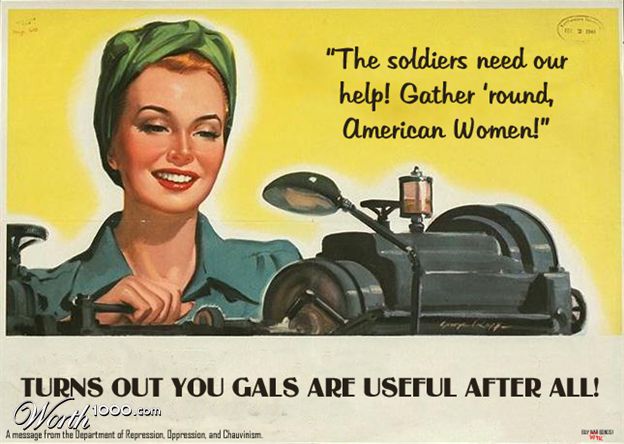
Will it make a difference? Probably not. But, maybe it will. And, maybe, if more people would stand up to this sort of behavior, things would change. Ultimately, if we all want a world free of misogyny, then we must take a stand, confront it as it occurs, and demand better treatment, whether it is directed at us or at those around us.

One thing is certain: if we remain silent, the misogynist wins.

‘Rights Here, Right Now!’

XVIII International AIDS Conference

The XVIII International AIDS Conference gets underway in Vienna this week.

This week, an estimated 25,000 individuals from across the globe who all work in one way or another on issues related to HIV will descend upon the fine city of Vienna for the XVIII International AIDS Conference.

The theme for this year’s event is ‘Rights Here, Right Now’, which refers to the connection between HIV and human rights.

How far have we come in meeting the needs of those affected by HIV in the past 25 years or so? Where is more work yet needed? How do national responses compare to one another? What success stories exist and how may they be adopted to other contexts? And, what human rights violations continue to undermine the responses to HIV, locally, nationally, regionally and globally?

These are a few of the questions that come to mind before the event. The first of those in particular has been on my mind lately.

I recently caught the Frontline special report from 2006, The Age of AIDS.  This sobering documentary chronicles the early days of the epidemic in the US, and then provides an overview of the global epidemic. It is available to watch online, and I encourage everyone to spend the time doing so.

What struck me is that many of the same issues that plagued the responses in the early stages of the epidemic continue to undermine our work. Stigma, discrimination, drugs pricing policies and treatment availability, and a lack of basic information at times. Strong leadership along with political will and determination could remove and/or minimise these barriers. And, would go a long, long way in honouring the human rights of those living with and affected by HIV.

There is a moment in the documentary when Dr Jonathan Mann, one of the early pioneers in the response to the global pandemic, states, ‘It’s about basic equity, simple justice’. This short yet poignant declaration was in reference to addressing the stigma and discrimination and horrendous human suffering experienced by those who literally had no hope and faced certain death in the early stages of the epidemic.

It is still about equity. And, it is still about social justice more than 25 years on.

In the current economic climate, many programmes which have allowed millions of individuals who had no hope and were close to death access to live-saving treatments (which have improved their overall quality of life) will come to an end. As programmes lose vital funding from development aid programmes, the real tragedy is that individuals will suffer. Individuals will die. Most of those individuals will be those who live in lesser developed countries and have no where else to turn for assistance.

Is that fulfilling the commitment to universal human rights we have argued and fought for?

A peaceful demonstration will be held Sunday, 18 July, 17.

Broken Promises Kill: No reTREAT, Fund AIDS

A peaceful demonstration will urge governments and global leaders to honour their commitments to fund AIDS programmes

00–19.00, at the Vienna Conference Centre, to coincide with the opening ceremony. Governments across across the globe have failed to fulfill their commitments to fund AIDS treatment and other health needs.

And, they must be held to account.

I for one will join others in Vienna to protest the broken promises and threat to upholding the human rights of those affected by the epidemic on Sunday, 18 July. I will be there not for my own rights, but for those who have no other voice. I will be there for those who are not in Vienna.

Happy World Environment Day 2010

The United Nations Environment Programme celebrates World Environment Day on 5 June this year.

The idea behind WED is to ‘celebrate positive action for the environment’. Tree plantings and naming baby gorillas provide Rwandans with an opportunity to celebrate their country’s rich ecological niche. Bahrain organised a Cultural Environment Week which folds in nicely as a part of the International Year of Biodiversity. Arts and essay competitions along with photo exhibitions have been combined in many countries with invitations extended to local artisans to create works that focus on biodiversity and the ecological riches found the world over.

Contrast the idea of WED to the travesty occurring in the Gulf of Mexico at the moment.

An oil-covered brown pelican found on the Louisiana Coast on 4 June 2010. Photo by Win McNamee/Getty Images, reposted from The Huffington Post.

A few days ago, new images of pelicans and other seabirds, dead fish and dolphins appeared, all of which were covered in oil from the Deepwater Horizon oil spill. The images were vile and stomach-churning to say the least. I’ve seen a few news items within the past few weeks where some claim that the impact on the eco-system surrounding the spill won’t be impacted too badly. The damage won’t be ‘that bad’.

My question to those who make such claims is this: what do you consider ‘not that bad’?

There are so many things about the tragedy in the Gulf that impact those beyond the workers on the platform or the company (-ies) losing precious cash. Those who live in the Gulf will be perhaps impacted the most—from the fishermen who benefit from the delicate eco-systems to those who work in the tourism industry in a region of the US that is amazingly beautiful. With news that the Gulf currents could extend the effects of the spill up the Eastern seaboard and beyond, another place close to my heart could also be profoundly impacted—Cuba. If it took the area effected by the Exxon Valdez oil spill 30 years to recover, how long will it take the Gulf? And, is the immediate pay off worth the sacrifice?

Our—Americans’—reliance on oil is and has been gluttonous. On World Environment Day, shouldn’t we consider the impact of that gluttony and move towards less detrimental means of enjoying our way of life?